

Valid Microsoft Azure DP-300 Dumps Ensure Your Passing
DP-300 Dumps Real Exam Questions Test Engine Dumps Training
Configure Query Performance: 5-10%
- Review Index Design & Database Table: The skills covered in this topic include evaluating index design for performance, table partitioning strategy, and compression for indexes and table usage.
- Review Query Plans: The test takers should be able to establish the problem areas within execution plans and determine the relevant execution plan type.
- Assess Performance Improvement: The competence required in this domain includes identifying performance concerns with DMVs and evaluating the utilization of hints regarding query performance.
NEW QUESTION 32
You have SQL Server on Azure virtual machines in an availability group.
You have a database named DB1 that is NOT in the availability group.
You create a full database backup of DB1.
You need to add DB1 to the availability group.
Which restore option should you use on the secondary replica?
- A. Restore with Standby
- B. Restore with Recovery
- C. Restore with Norecovery
Answer: C
Explanation:
Prepare a secondary database for an Always On availability group requires two steps:
1. Restore a recent database backup of the primary database and subsequent log backups onto each server instance that hosts the secondary replica, using RESTORE WITH NORECOVERY
2. Join the restored database to the availability group.
Reference:
https://docs.microsoft.com/en-us/sql/database-engine/availability-groups/windows/manually-prepare-asecondary- database-for-an-availability-group-sql-server
NEW QUESTION 33
DRAG DROP
You have a new Azure SQL database named DB1 on an Azure SQL server named AzSQL1.
The only user who was created is the server administrator.
You need to create a contained database user in DB1 who will use Azure Active Directory (Azure AD) for
authentication.
Which three actions should you perform in sequence? To answer, move the appropriate actions from the list of
actions to the answer area and arrange them in the correct order.
Select and Place: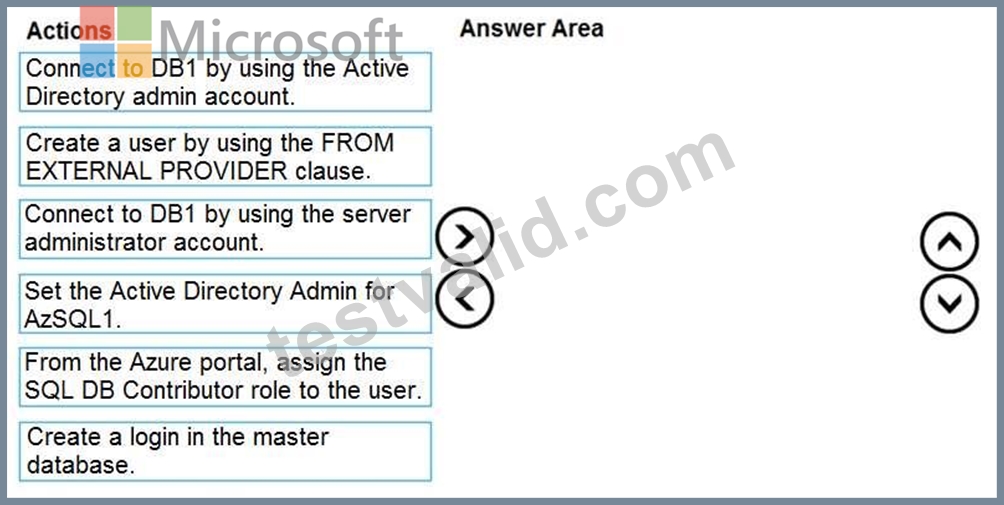
Answer:
Explanation: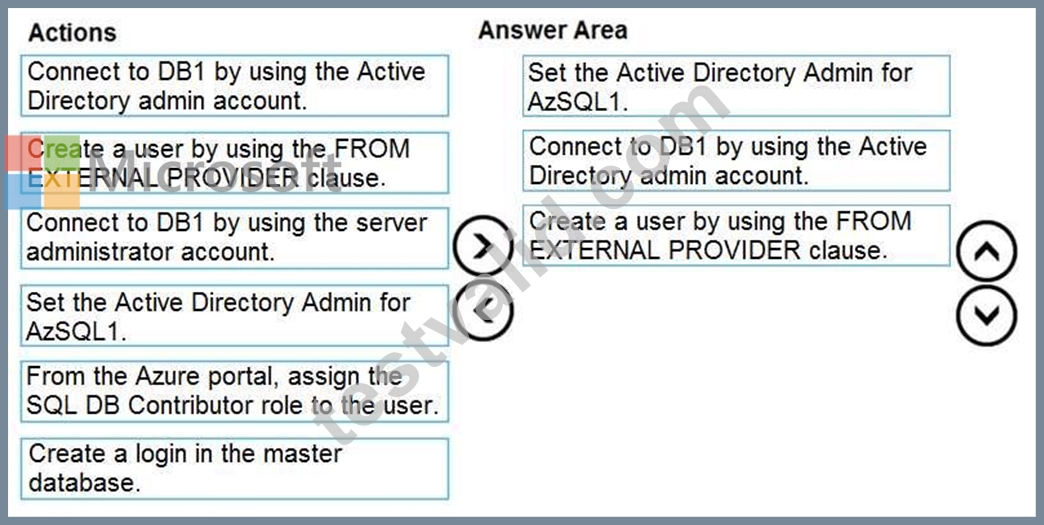
Section: [none]
Explanation:
Step 1: Set up the Active Directory Admin for AzSQL1.
Step 2: Connect to DB1 by using the server administrator.
Sign into your managed instance with an Azure AD login granted with the sysadmin role.
Step 3: Create a user by using the FROM EXTERNAL PROVIDER clause.
FROM EXTERNAL PROVIDER is available for creating server-level Azure AD logins in SQL Database
managed instance. Azure AD logins allow database-level Azure AD principals to be mapped to server-level
Azure AD logins. To create an Azure AD user from an Azure AD login use the following syntax:
CREATE USER [AAD_principal] FROM LOGIN [Azure AD login]
Reference:
https://docs.microsoft.com/en-us/sql/t-sql/statements/create-user-transact-sql
NEW QUESTION 34
You are evaluating the role assignments.
For each of the following statements, select Yes if the statement is true. Otherwise, select No.
NOTE: Each correct selection is worth one point.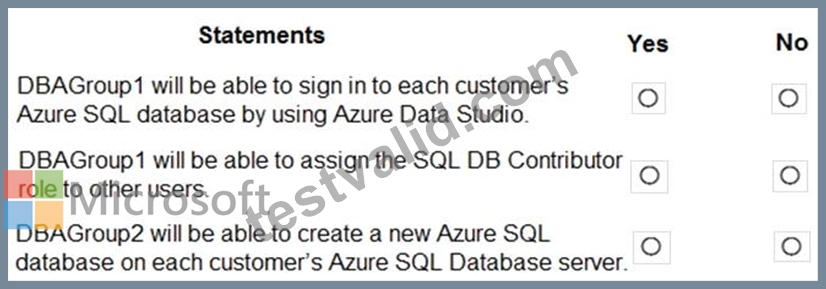
Answer:
Explanation:
Reference:
https://docs.microsoft.com/en-us/azure/role-based-access-control/built-in-roles
NEW QUESTION 35
You receive numerous alerts from Azure Monitor for an Azure SQL database.
You need to reduce the number of alerts. You must only receive alerts if there is a significant change in usage
patterns for an extended period.
Which two actions should you perform? Each correct answer presents part of the solution.
NOTE: Each correct selection is worth one point.
- A. Set Threshold Sensitivity to High
- B. Set Force Plan to On
- C. Set the Alert logic threshold to Dynamic
- D. Set the Alert logic threshold to Static
- E. Set Threshold Sensitivity to Low
Answer: C,E
Explanation:
Section: [none]
Explanation:
B: Dynamic Thresholds continuously learns the data of the metric series and tries to model it using a set of
algorithms and methods. It detects patterns in the data such as seasonality (Hourly / Daily / Weekly), and is
able to handle noisy metrics (such as machine CPU or memory) as well as metrics with low dispersion (such as
availability and error rate).
D: Alert threshold sensitivity is a high-level concept that controls the amount of deviation from metric behavior
required to trigger an alert.
Low - The thresholds will be loose with more distance from metric series pattern. An alert rule will only trigger
on large deviations, resulting in fewer alerts.
Incorrect Answers:
A: High - The thresholds will be tight and close to the metric series pattern. An alert rule will be triggered on the
smallest deviation, resulting in more alerts.
Reference:
https://docs.microsoft.com/en-us/azure/azure-monitor/platform/alerts-dynamic-thresholds
NEW QUESTION 36
DRAG DROP
You are creating a managed data warehouse solution on Microsoft Azure.
You must use PolyBase to retrieve data from Azure Blob storage that resides in parquet format and load the data into a large table called FactSalesOrderDetails.
You need to configure Azure Synapse Analytics to receive the data.
Which four actions should you perform in sequence? To answer, move the appropriate actions from the list of actions to the answer area and arrange them in the correct order.
Select and Place:
Answer:
Explanation:
Section: [none]
Explanation:
To query the data in your Hadoop data source, you must define an external table to use in Transact-SQL queries. The following steps describe how to configure the external table.
Step 1: Create a master key on database.
1. Create a master key on the database. The master key is required to encrypt the credential secret.
(Create a database scoped credential for Azure blob storage.)
Step 2: Create an external data source for Azure Blob storage.
2. Create an external data source with CREATE EXTERNAL DATA SOURCE..
Step 3: Create an external file format to map the parquet files.
3. Create an external file format with CREATE EXTERNAL FILE FORMAT.
Step 4. Create an external table FactSalesOrderDetails
4. Create an external table pointing to data stored in Azure storage with CREATE EXTERNAL TABLE.
Reference:
https://docs.microsoft.com/en-us/sql/relational-databases/polybase/polybase-configure-azure-blob-storage
NEW QUESTION 37
You have an Azure SQL database named sqldb1.
You need to minimize the amount of space by the data and log files of sqldb1.
What should you run?
- A. sp_clean_db_free_space
- B. DBCC SHRINKDATABASE
- C. DBCC SHRINKFILE
- D. sp_clean_db_file_free_space
Answer: B
Explanation:
DBCC SHRINKDATABASE shrinks the size of the data and log files in the specified database.
Incorrect Answers:
D: To shrink one data or log file at a time for a specific database, execute the DBCC SHRINKFILE command.
Reference:
https://docs.microsoft.com/en-us/sql/t-sql/database-console-commands/dbcc-shrinkdatabase-transact-sql
NEW QUESTION 38
Note: This question is part of a series of questions that present the same scenario. Each question in the series contains a unique solution that might meet the stated goals. Some question sets might have more than one correct solution, while others might not have a correct solution.
After you answer a question in this section, you will NOT be able to return to it. As a result, these questions will not appear in the review screen.
You have an Azure Data Lake Storage account that contains a staging zone.
You need to design a daily process to ingest incremental data from the staging zone, transform the data by executing an R script, and then insert the transformed data into a data warehouse in Azure Synapse Analytics.
Solution: You use an Azure Data Factory schedule trigger to execute a pipeline that copies the data to a staging table in the data warehouse, and then uses a stored procedure to execute the R script.
Does this meet the goal?
- A. No
- B. Yes
Answer: B
Explanation:
If you need to transform data in a way that is not supported by Data Factory, you can create a custom activity with your own data processing logic and use the activity in the pipeline. You can create a custom activity to run R scripts on your HDInsight cluster with R installed.
Reference:
https://docs.microsoft.com/en-US/azure/data-factory/transform-data
NEW QUESTION 39
You plan to move two 100-GB databases to Azure.
You need to dynamically scale resources consumption based on workloads. The solution must minimize downtime during scaling operations.
What should you use?
- A. two databases hosted in SQL Server on an Azure virtual machine
- B. two databases in an Azure SQL Managed instance
- C. two single Azure SQL databases
- D. two Azure SQL Databases in an elastic pool
Answer: D
Explanation:
Section: [none]
Explanation:
Azure SQL Database elastic pools are a simple, cost-effective solution for managing and scaling multiple databases that have varying and unpredictable usage demands. The databases in an elastic pool are on a single server and share a set number of resources at a set price.
Reference:
https://docs.microsoft.com/en-us/azure/azure-sql/database/elastic-pool-overview
NEW QUESTION 40
DRAG DROP
You have an Azure SQL database that contains a table named Employees. Employees contains a column named Salary.
You need to encrypt the Salary column. The solution must prevent database administrators from reading the data in the Salary column and must provide the most secure encryption.
Which three actions should you perform in sequence? To answer, move the appropriate actions from the list of actions to the answer area and arrange them in the correct order.
Select and Place:
Answer:
Explanation:
Explanation:
Step 1: Create a column master key
Create a column master key metadata entry before you create a column encryption key metadata entry in the database and before any column in the database can be encrypted using Always Encrypted.
Step 2: Create a column encryption key.
Step 3: Encrypt the Salary column by using the randomized encryption type.
Randomized encryption uses a method that encrypts data in a less predictable manner. Randomized encryption is more secure, but prevents searching, grouping, indexing, and joining on encrypted columns.
Note: A column encryption key metadata object contains one or two encrypted values of a column encryption key that is used to encrypt data in a column. Each value is encrypted using a column master key.
Incorrect Answers:
Deterministic encryption.
Deterministic encryption always generates the same encrypted value for any given plain text value. Using deterministic encryption allows point lookups, equality joins, grouping and indexing on encrypted columns.
However, it may also allow unauthorized users to guess information about encrypted values by examining patterns in the encrypted column, especially if there's a small set of possible encrypted values, such as True/ False, or North/South/East/West region.
Reference:
https://docs.microsoft.com/en-us/sql/relational-databases/security/encryption/always-encrypted-database- engine Monitor and Optimize Operational Resources Testlet 1 This is a case study. Case studies are not timed separately. You can use as much exam time as you would like to complete each case. However, there may be additional case studies and sections on this exam. You must manage your time to ensure that you are able to complete all questions included on this exam in the time provided.
To answer the questions included in a case study, you will need to reference information that is provided in the case study. Case studies might contain exhibits and other resources that provide more information about the scenario that is described in the case study. Each question is independent of the other questions in this case study.
At the end of this case study, a review screen will appear. This screen allows you to review your answers and to make changes before you move to the next section of the exam. After you begin a new section, you cannot return to this section.
To start the case study
To display the first question in this case study, click the Next button. Use the buttons in the left pane to explore the content of the case study before you answer the questions. Clicking these buttons displays information such as business requirements, existing environment, and problem statements. If the case study has an All Information tab, note that the information displayed is identical to the information displayed on the subsequent tabs. When you are ready to answer a question, click the Question button to return to the question.
Existing Environment
Network Environment
The manufacturing and research datacenters connect to the primary datacenter by using a VPN.
The primary datacenter has an ExpressRoute connection that uses both Microsoft peering and private peering.
The private peering connects to an Azure virtual network named HubVNet.
Identity Environment
Litware has a hybrid Azure Active Directory (Azure AD) deployment that uses a domain named litwareinc.com.
All Azure subscriptions are associated to the litwareinc.com Azure AD tenant.
Database Environment
The sales department has the following database workload:
* An on-premises named SERVER1 hosts an instance of Microsoft SQL Server 2012 and two 1-TB databases.
* A logical server named SalesSrv01A contains a geo-replicated Azure SQL database named SalesSQLDb1.
SalesSQLDb1 is in an elastic pool named SalesSQLDb1Pool. SalesSQLDb1 uses database firewall rules and contained database users.
* An application named SalesSQLDb1App1 uses SalesSQLDb1.
The manufacturing office contains two on-premises SQL Server 2016 servers named SERVER2 and SERVER3. The servers are nodes in the same Always On availability group. The availability group contains a database named ManufacturingSQLDb1 Database administrators have two Azure virtual machines in HubVnet named VM1 and VM2 that run Windows Server 2019 and are used to manage all the Azure databases.
Licensing Agreement
Litware is a Microsoft Volume Licensing customer that has License Mobility through Software Assurance.
Current Problems
SalesSQLDb1 experiences performance issues that are likely due to out-of-date statistics and frequent blocking queries.
Requirements
Planned Changes
Litware plans to implement the following changes:
* Implement 30 new databases in Azure, which will be used by time-sensitive manufacturing apps that have varying usage patterns. Each database will be approximately 20 GB.
* Create a new Azure SQL database named ResearchDB1 on a logical server named ResearchSrv01.
ResearchDB1 will contain Personally Identifiable Information (PII) data.
* Develop an app named ResearchApp1 that will be used by the research department to populate and access ResearchDB1.
* Migrate ManufacturingSQLDb1 to the Azure virtual machine platform.
* Migrate the SERVER1 databases to the Azure SQL Database platform.
Technical Requirements
Litware identifies the following technical requirements:
* Maintenance tasks must be automated.
* The 30 new databases must scale automatically.
* The use of an on-premises infrastructure must be minimized.
* Azure Hybrid Use Benefits must be leveraged for Azure SQL Database deployments.
* All SQL Server and Azure SQL Database metrics related to CPU and storage usage and limits must be analyzed by using Azure built-in functionality.
Security and Compliance Requirements
Litware identifies the following security and compliance requirements:
* Store encryption keys in Azure Key Vault.
* Retain backups of the PII data for two months.
* Encrypt the PII data at rest, in transit, and in use.
* Use the principle of least privilege whenever possible.
* Authenticate database users by using Active Directory credentials.
* Protect Azure SQL Database instances by using database-level firewall rules.
* Ensure that all databases hosted in Azure are accessible from VM1 and VM2 without relying on public endpoints.
Business Requirements
Litware identifies the following business requirements:
* Meet an SLA of 99.99% availability for all Azure deployments.
* Minimize downtime during the migration of the SERVER1 databases.
* Use the Azure Hybrid Use Benefits when migrating workloads to Azure.
* Once all requirements are met, minimize costs whenever possible.
NEW QUESTION 41
HOTSPOT
You have SQL Server on an Azure virtual machine.
You review the query plan shown in the following exhibit.
For each of the following statements, select yes if the statement is true. Otherwise, select no.
NOTE: Each correct selection is worth one point.
Hot Area: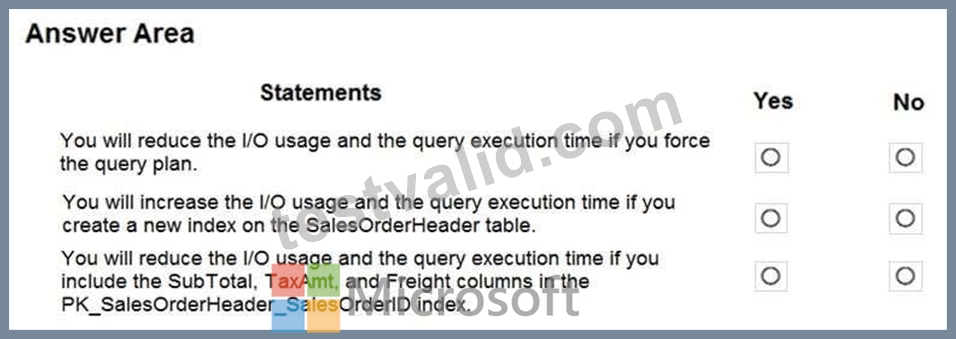
Answer:
Explanation:
Section: [none]
Explanation/Reference:
https://docs.microsoft.com/en-us/sql/relational-databases/performance/monitoring-performance-by-using-the-
query-store
NEW QUESTION 42
You have an Azure SQL Database instance named DatabaseA on a server named Server1.
You plan to add a new user named App1 to DatabaseA and grant App1 db_datacenter permissions. App1 will use SQL Server Authentication.
You need to create App1. The solution must ensure that App1 can be given access to other databases by using the same credentials.
Which three actions should you perform in sequence? To answer, move the appropriate actions from the list of actions to the answer area and arrange them in the correct order.
Answer:
Explanation:
Explanation:
Step 1: On the master database, run CREATE LOGIN [App1] WITH PASSWORD = 'p@aaW0rd!' Logins are server wide login and password pairs, where the login has the same password across all databases. Here is some sample Transact-SQL that creates a login:
CREATE LOGIN readonlylogin WITH password='1231!#ASDF!a';
You must be connected to the master database on SQL Azure with the administrative login (which you get from the SQL Azure portal) to execute the CREATE LOGIN command.
Step 2: On DatabaseA, run CREATE USER [App1] FROM LOGIN [App1]
Users are created per database and are associated with logins. You must be connected to the database in where you want to create the user. In most cases, this is not the master database. Here is some sample Transact-SQL that creates a user:
CREATE USER readonlyuser FROM LOGIN readonlylogin;
Step 3: On DatabaseA run ALTER ROLE db_datareader ADD Member [App1]
Just creating the user does not give them permissions to the database. You have to grant them access. In the Transact-SQL example below the readonlyuser is given read only permissions to the database via the db_datareader role.
EXEC sp_addrolemember 'db_datareader', 'readonlyuser';
Reference:
https://azure.microsoft.com/en-us/blog/adding-users-to-your-sql-azure-database/
NEW QUESTION 43
DRAG DROP
You need to apply 20 built-in Azure Policy definitions to all new and existing Azure SQL Database deployments in an Azure subscription. The solution must minimize administrative effort.
Which three actions should you perform in sequence? To answer, move the appropriate actions from the list of actions to the answer area and arrange them in the correct order.
Select and Place: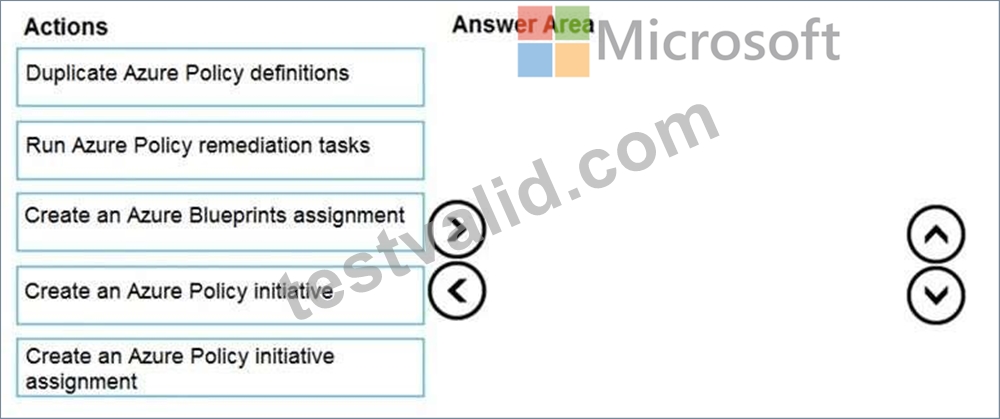
Answer:
Explanation: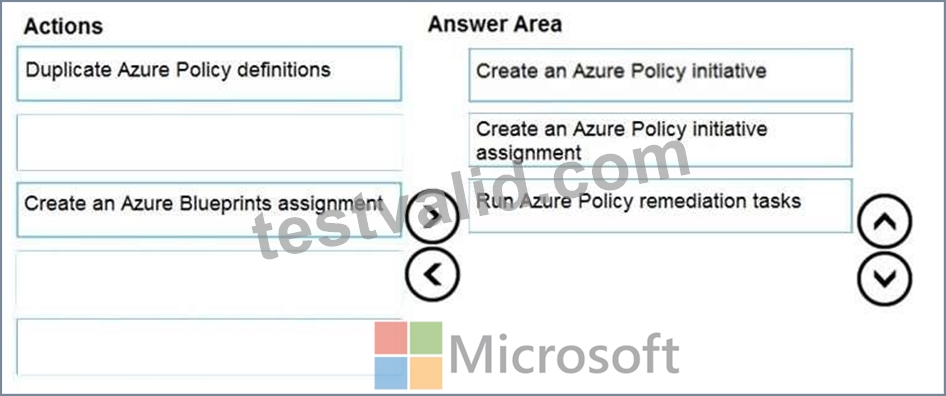
Section: [none]
Explanation:
Step 1: Create an Azure Policy Initiative
The first step in enforcing compliance with Azure Policy is to assign a policy definition. A policy definition defines under what condition a policy is enforced and what effect to take.
With an initiative definition, you can group several policy definitions to achieve one overarching goal. An initiative evaluates resources within scope of the assignment for compliance to the included policies.
Step 2: Create an Azure Policy Initiative assignment
Assign the initiative definition you created in the previous step.
Step 3: Run Azure Policy remediation tasks
To apply the Policy Initiative to the existing SQL databases.
Reference:
https://docs.microsoft.com/en-us/azure/governance/policy/tutorials/create-and-manage
NEW QUESTION 44
Note: This question is part of a series of questions that present the same scenario. Each question in
the series contains a unique solution that might meet the stated goals. Some question sets might have
more than one correct solution, while others might not have a correct solution.
After you answer a question in this section, you will NOT be able to return to it. As a result, these
questions will not appear in the review screen.
You have two Azure SQL Database servers named Server1 and Server2. Each server contains an Azure SQL
database named Database1.
You need to restore Database1 from Server1 to Server2. The solution must replace the existing Database1 on
Server2.
Solution: From the Azure portal, you delete Database1 from Server2, and then you create a new database on
Server2 by using the backup of Database1 from Server1.
Does this meet the goal?
- A. No
- B. Yes
Answer: A
Explanation:
Section: [none]
Explanation:
Instead restore Database1 from Server1 to the Server2 by using the RESTORE Transact-SQL command and
the REPLACE option.
Note: REPLACE should be used rarely and only after careful consideration. Restore normally prevents
accidentally overwriting a database with a different database. If the database specified in a RESTORE
statement already exists on the current server and the specified database family GUID differs from the
database family GUID recorded in the backup set, the database is not restored. This is an important safeguard.
Reference:
https://docs.microsoft.com/en-us/sql/t-sql/statements/restore-statements-transact-sql
NEW QUESTION 45
You have SQL Server 2019 on an Azure virtual machine that runs Windows Server 2019. The virtual machine has 4 vCPUs and 28 GB of memory.
You scale up the virtual machine to 8 vCPUSs and 64 GB of memory.
You need to provide the lowest latency for tempdb.
What is the total number of data files that tempdb should contain?
- A. 0
- B. 1
- C. 2
- D. 3
Answer: C
Explanation:
The number of files depends on the number of (logical) processors on the machine. As a general rule, if the number of logical processors is less than or equal to eight, use the same number of data files as logical processors. If the number of logical processors is greater than eight, use eight data files and then if contention continues, increase the number of data files by multiples of 4 until the contention is reduced to acceptable levels or make changes to the workload/code.
Reference:
https://docs.microsoft.com/en-us/sql/relational-databases/databases/tempdb-database Optimize Query Performance Testlet 1 This is a case study. Case studies are not timed separately. You can use as much exam time as you would like to complete each case. However, there may be additional case studies and sections on this exam. You must manage your time to ensure that you are able to complete all questions included on this exam in the time provided.
To answer the questions included in a case study, you will need to reference information that is provided in the case study. Case studies might contain exhibits and other resources that provide more information about the scenario that is described in the case study. Each question is independent of the other questions in this case study.
At the end of this case study, a review screen will appear. This screen allows you to review your answers and to make changes before you move to the next section of the exam. After you begin a new section, you cannot return to this section.
To start the case study
To display the first question in this case study, click the Next button. Use the buttons in the left pane to explore the content of the case study before you answer the questions. Clicking these buttons displays information such as business requirements, existing environment, and problem statements. If the case study has an All Information tab, note that the information displayed is identical to the information displayed on the subsequent tabs. When you are ready to answer a question, click the Question button to return to the question.
Overview
Litware, Inc. is a renewable energy company that has a main office in Boston. The main office hosts a sales department and the primary datacenter for the company.
Physical Locations
Existing Environment
Litware has a manufacturing office and a research office is separate locations near Boston. Each office has its own datacenter and internet connection.
The manufacturing and research datacenters connect to the primary datacenter by using a VPN.
Network Environment
The primary datacenter has an ExpressRoute connection that uses both Microsoft peering and private peering.
The private peering connects to an Azure virtual network named HubVNet.
Identity Environment
Litware has a hybrid Azure Active Directory (Azure AD) deployment that uses a domain named litwareinc.com.
All Azure subscriptions are associated to the litwareinc.com Azure AD tenant.
Database Environment
The sales department has the following database workload:
* An on-premises named SERVER1 hosts an instance of Microsoft SQL Server 2012 and two 1-TB databases.
* A logical server named SalesSrv01A contains a geo-replicated Azure SQL database named SalesSQLDb1.
SalesSQLDb1 is in an elastic pool named SalesSQLDb1Pool. SalesSQLDb1 uses database firewall rules and contained database users.
* An application named SalesSQLDb1App1 uses SalesSQLDb1.
The manufacturing office contains two on-premises SQL Server 2016 servers named SERVER2 and SERVER3. The servers are nodes in the same Always On availability group. The availability group contains a database named ManufacturingSQLDb1 Database administrators have two Azure virtual machines in HubVnet named VM1 and VM2 that run Windows Server 2019 and are used to manage all the Azure databases.
Licensing Agreement
Litware is a Microsoft Volume Licensing customer that has License Mobility through Software Assurance.
Current Problems
SalesSQLDb1 experiences performance issues that are likely due to out-of-date statistics and frequent blocking queries.
Requirements
Planned Changes
Litware plans to implement the following changes:
* Implement 30 new databases in Azure, which will be used by time-sensitive manufacturing apps that have varying usage patterns. Each database will be approximately 20 GB.
* Create a new Azure SQL database named ResearchDB1 on a logical server named ResearchSrv01.
ResearchDB1 will contain Personally Identifiable Information (PII) data.
* Develop an app named ResearchApp1 that will be used by the research department to populate and access ResearchDB1.
* Migrate ManufacturingSQLDb1 to the Azure virtual machine platform.
* Migrate the SERVER1 databases to the Azure SQL Database platform.
Technical Requirements
Litware identifies the following technical requirements:
* Maintenance tasks must be automated.
* The 30 new databases must scale automatically.
* The use of an on-premises infrastructure must be minimized.
* Azure Hybrid Use Benefits must be leveraged for Azure SQL Database deployments.
* All SQL Server and Azure SQL Database metrics related to CPU and storage usage and limits must be analyzed by using Azure built-in functionality.
Security and Compliance Requirements
Litware identifies the following security and compliance requirements:
* Store encryption keys in Azure Key Vault.
* Retain backups of the PII data for two months.
* Encrypt the PII data at rest, in transit, and in use.
* Use the principle of least privilege whenever possible.
* Authenticate database users by using Active Directory credentials.
* Protect Azure SQL Database instances by using database-level firewall rules.
* Ensure that all databases hosted in Azure are accessible from VM1 and VM2 without relying on public endpoints.
Business Requirements
Litware identifies the following business requirements:
* Meet an SLA of 99.99% availability for all Azure deployments.
* Minimize downtime during the migration of the SERVER1 databases.
* Use the Azure Hybrid Use Benefits when migrating workloads to Azure.
* Once all requirements are met, minimize costs whenever possible.
NEW QUESTION 46
You have an Azure Stream Analytics job.
You need to ensure that the job has enough streaming units provisioned.
You configure monitoring of the SU % Utilization metric.
Which two additional metrics should you monitor? Each correct answer presents part of the solution.
NOTE: Each correct selection is worth one point.
- A. Out of order Events
- B. Watermark Delay
- C. Late Input Events
- D. Function Events
- E. Backlogged Input Events
Answer: B,E
Explanation:
To react to increased workloads and increase streaming units, consider setting an alert of 80% on the SU Utilization metric. Also, you can use watermark delay and backlogged events metrics to see if there is an impact.
Note: Backlogged Input Events: Number of input events that are backlogged. A non-zero value for this metric implies that your job isn't able to keep up with the number of incoming events. If this value is slowly increasing or consistently non-zero, you should scale out your job, by increasing the SUs.
Reference:
https://docs.microsoft.com/en-us/azure/stream-analytics/stream-analytics-monitoring
NEW QUESTION 47
Note: This question is part of a series of questions that present the same scenario. Each question in
the series contains a unique solution that might meet the stated goals. Some question sets might have
more than one correct solution, while others might not have a correct solution.
After you answer a question in this section, you will NOT be able to return to it. As a result, these
questions will not appear in the review screen.
You have an Azure SQL database named Sales.
You need to implement disaster recovery for Sales to meet the following requirements:
* During normal operations, provide at least two readable copies of Sales.
* Ensure that Sales remains available if a datacenter fails.
Solution: You deploy an Azure SQL database that uses the General Purpose service tier and failover groups.
Does this meet the goal?
- A. No
- B. Yes
Answer: A
Explanation:
Section: [none]
Explanation:
Instead deploy an Azure SQL database that uses the Business Critical service tier and Availability Zones.
Note: Premium and Business Critical service tiers leverage the Premium availability model, which integrates
compute resources (sqlservr.exe process) and storage (locally attached SSD) on a single node. High
availability is achieved by replicating both compute and storage to additional nodes creating a three to four-
node cluster.
By default, the cluster of nodes for the premium availability model is created in the same datacenter. With the
introduction of Azure Availability Zones, SQL Database can place different replicas of the Business Critical
database to different availability zones in the same region. To eliminate a single point of failure, the control ring
is also duplicated across multiple zones as three gateway rings (GW).
Reference:
https://docs.microsoft.com/en-us/azure/azure-sql/database/high-availability-sla
NEW QUESTION 48
Which audit log destination should you use to meet the monitoring requirements?
- A. Azure Storage
- B. Azure Log Analytics
- C. Azure Event Hubs
Answer: B
Explanation:
Scenario: Use a single dashboard to review security and audit data for all the PaaS databases.
With dashboards can bring together operational data that is most important to IT across all your Azure resources, including telemetry from Azure Log Analytics.
Note: Auditing for Azure SQL Database and Azure Synapse Analytics tracks database events and writes them to an audit log in your Azure storage account, Log Analytics workspace, or Event Hubs.
Reference:
https://docs.microsoft.com/en-us/azure/azure-monitor/visualize/tutorial-logs-dashboards
Topic 2, Litware
Existing Environment
Network Environment
The manufacturing and research datacenters connect to the primary datacenter by using a VPN.
The primary datacenter has an ExpressRoute connection that uses both Microsoft peering and private peering. The private peering connects to an Azure virtual network named HubVNet.
Identity Environment
Litware has a hybrid Azure Active Directory (Azure AD) deployment that uses a domain named litwareinc.com. All Azure subscriptions are associated to the litwareinc.com Azure AD tenant.
Database Environment
The sales department has the following database workload:
An on-premises named SERVER1 hosts an instance of Microsoft SQL Server 2012 and two 1-TB databases.
A logical server named SalesSrv01A contains a geo-replicated Azure SQL database named SalesSQLDb1. SalesSQLDb1 is in an elastic pool named SalesSQLDb1Pool. SalesSQLDb1 uses database firewall rules and contained database users.
An application named SalesSQLDb1App1 uses SalesSQLDb1.
The manufacturing office contains two on-premises SQL Server 2016 servers named SERVER2 and SERVER3. The servers are nodes in the same Always On availability group. The availability group contains a database named ManufacturingSQLDb1 Database administrators have two Azure virtual machines in HubVnet named VM1 and VM2 that run Windows Server 2019 and are used to manage all the Azure databases.
Licensing Agreement
Litware is a Microsoft Volume Licensing customer that has License Mobility through Software Assurance.
Current Problems
SalesSQLDb1 experiences performance issues that are likely due to out-of-date statistics and frequent blocking queries.
Requirements
Planned Changes
Litware plans to implement the following changes:
Implement 30 new databases in Azure, which will be used by time-sensitive manufacturing apps that have varying usage patterns. Each database will be approximately 20 GB.
Create a new Azure SQL database named ResearchDB1 on a logical server named ResearchSrv01. ResearchDB1 will contain Personally Identifiable Information (PII) data.
Develop an app named ResearchApp1 that will be used by the research department to populate and access ResearchDB1.
Migrate ManufacturingSQLDb1 to the Azure virtual machine platform.
Migrate the SERVER1 databases to the Azure SQL Database platform.
Technical Requirements
Litware identifies the following technical requirements:
Maintenance tasks must be automated.
The 30 new databases must scale automatically.
The use of an on-premises infrastructure must be minimized.
Azure Hybrid Use Benefits must be leveraged for Azure SQL Database deployments.
All SQL Server and Azure SQL Database metrics related to CPU and storage usage and limits must be analyzed by using Azure built-in functionality.
Security and Compliance Requirements
Litware identifies the following security and compliance requirements:
Store encryption keys in Azure Key Vault.
Retain backups of the PII data for two months.
Encrypt the PII data at rest, in transit, and in use.
Use the principle of least privilege whenever possible.
Authenticate database users by using Active Directory credentials.
Protect Azure SQL Database instances by using database-level firewall rules.
Ensure that all databases hosted in Azure are accessible from VM1 and VM2 without relying on public endpoints.
Business Requirements
Litware identifies the following business requirements:
Meet an SLA of 99.99% availability for all Azure deployments.
Minimize downtime during the migration of the SERVER1 databases.
Use the Azure Hybrid Use Benefits when migrating workloads to Azure.
Once all requirements are met, minimize costs whenever possible.
NEW QUESTION 49
DRAG DROP
You have SQL Server on an Azure virtual machine that contains a database named DB1. DB1 is 30 TB and has a 1-GB daily rate of change.
You back up the database by using a Microsoft SQL Server Agent job that runs Transact-SQL commands. You perform a weekly full backup on Sunday, daily differential backups at 01:00 in the morning, and transaction log backups every five minutes.
The database fails on Wednesday at 10:00 in the morning.
Which three backups should you restore in sequence? To answer, move the appropriate backups from the list of backups to the answer area and arrange them in the correct order.
Select and Place: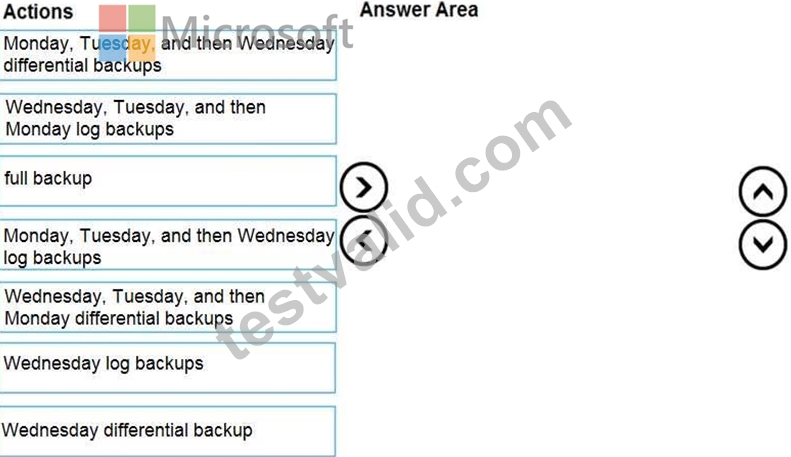
Answer:
Explanation:
Section: [none]
NEW QUESTION 50
You are building an Azure Stream Analytics job to retrieve game data.
You need to ensure that the job returns the highest scoring record for each five-minute time interval of each game.
How should you complete the Stream Analytics query? To answer, select the appropriate options in the answer area.
NOTE: Each correct selection is worth one point.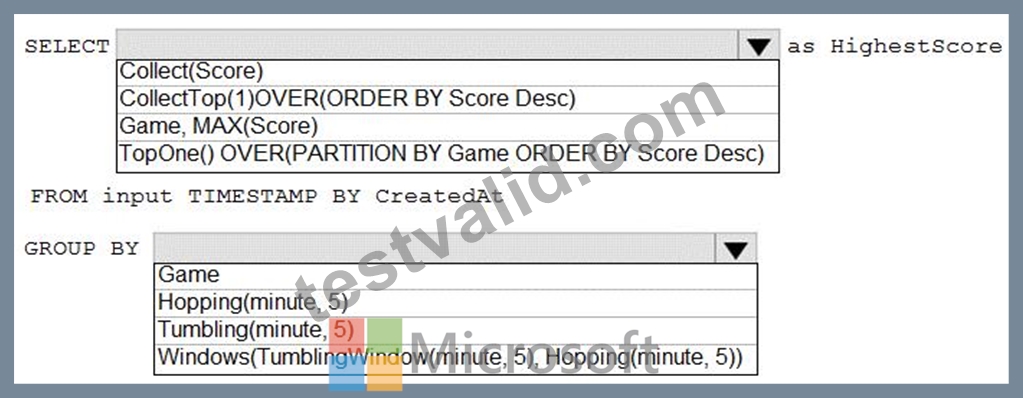
Answer:
Explanation:
Reference:
https://docs.microsoft.com/en-us/stream-analytics-query/topone-azure-stream-analytics
https://github.com/MicrosoftDocs/azure-docs/blob/master/articles/stream-analytics/stream-analytics-window-functions.md
NEW QUESTION 51
You have SQL Server on an Azure virtual machine named SQL1.
SQL1 has an agent job to back up all databases.
You add a user named dbadmin1 as a SQL Server Agent operator.
You need to ensure that dbadmin1 receives an email alert if a job fails.
Which three actions should you perform in sequence? To answer, move the appropriate actions from the list of actions to the answer area and arrange them in the correct order.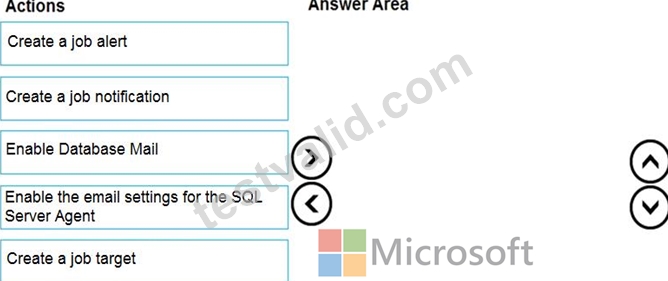
Answer:
Explanation: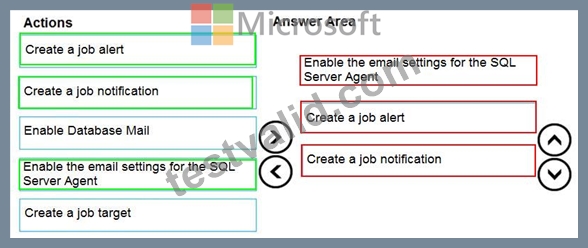
Explanation:
Step 1: Enable the email settings for the SQL Server Agent.
To send a notification in response to an alert, you must first configure SQL Server Agent to send mail.
Step 2: Create a job alert
Step 3: Create a job notification
Example:
-- adds an e-mail notification for the specified alert (Test Alert)
-- This example assumes that Test Alert already exists
-- and that Francois Ajenstat is a valid operator name.
USE msdb ;
GO
EXEC dbo.sp_add_notification
@alert_name = N'Test Alert',
@operator_name = N'Francois Ajenstat',
@notification_method = 1 ;
GO
Reference:
https://docs.microsoft.com/en-us/sql/ssms/agent/notify-an-operator-of-job-status
https://docs.microsoft.com/en-us/sql/ssms/agent/assign-alerts-to-an-operator
NEW QUESTION 52
You are building a database in an Azure Synapse Analytics serverless SQL pool.
You have data stored in Parquet files in an Azure Data Lake Storage Gen2 container.
Records are structured as shown in the following sample.
The records contain two applicants at most.
You need to build a table that includes only the address fields.
How should you complete the Transact-SQL statement? To answer, select the appropriate options in the answer area.
NOTE: Each correct selection is worth one point.
Answer:
Explanation:
Reference:
https://docs.microsoft.com/en-us/azure/synapse-analytics/sql/develop-tables-external-tables
NEW QUESTION 53
......
Microsoft DP-300: Selling Microsoft Azure Products and Solutions: https://www.testvalid.com/DP-300-exam-collection.html
DP-300 exam dumps and online Test Engine: https://drive.google.com/open?id=1Puzm79LP5XXZ1RIATW3drJiDiO1zB06z