

Use Real EC-COUNCIL Achieve the 312-39 Dumps - 100% Exam Passing Guarantee
Verified 312-39 Q&As - Pass Guarantee 312-39 Exam Dumps
NEW QUESTION # 25
Identify the attack, where an attacker tries to discover all the possible information about a target network before launching a further attack.
- A. Ransomware Attack
- B. Reconnaissance Attack
- C. DoS Attack
- D. Man-In-Middle Attack
Answer: B
Explanation:
A Reconnaissance Attack is a type of cyber attack where the attacker engages in activities to gather information about a target network before launching further attacks. This preliminary phase involves collecting data that could include network infrastructure details, system vulnerabilities, and other critical information that could be exploited in subsequent stages of an attack. Reconnaissance can be both passive, involving information gathering without directly interacting with the target system, or active, which may include more direct methods like port scanning.
References:The concept of Reconnaissance Attacks is detailed in EC-Council's cybersecurity resources, such as the Certified Threat Intelligence Analyst (C|TIA) program and articles on the Cyber Kill Chain, which describe reconnaissance as the first stage in a cyber attack12. These resources outline the methodologies and types of information gathered during reconnaissance, emphasizing its role in identifying potential attack vectors12.
NEW QUESTION # 26
Jane, a security analyst, while analyzing IDS logs, detected an event matching Regex /((\%3C)|<)((\%69)|i|(\%
49))((\%6D)|m|(\%4D))((\%67)|g|(\%47))[^\n]+((\%3E)|>)/|.
What does this event log indicate?
- A. Parameter Tampering Attack
- B. Directory Traversal Attack
- C. XSS Attack
- D. SQL Injection Attack
Answer: C
Explanation:
The regular expression provided in the question is designed to detect patterns that are typically found in XSS (Cross-Site Scripting) attacks. Here's a breakdown of the regex pattern:
* /((\%3C)|<) - This part of the pattern matches the encoded version of < which is %3C, or the symbol < itself. In HTML, this symbol denotes the start of a tag.
* ((\%69)|i|(\%49)) - This matches the encoded version of i which is %69, the lowercase i, or the encoded version of I which is %49.
* ((\%6D)|m|(\%4D)) - This matches the encoded version of m which is %6D, the lowercase m, or the encoded version of M which is %4D.
* ((\%67)|g|(\%47)) - This matches the encoded version of g which is %67, the lowercase g, or the encoded version of G which is %47.
* [^\n]+ - This part of the pattern matches one or more characters that are not a newline character.
* ((\%3E)|>) - This matches the encoded version of > which is %3E, or the symbol > itself, denoting the end of an HTML tag.
The combination of these patterns is looking for a string that resembles an HTML img tag, which is a common vector for XSS attacks. XSS attacks involve injecting malicious scripts into webpages viewed by other users, exploiting the trust a user has for a particular site. XSS attacks can occur when a web application uses unsanitized user input in the output it generates.
References: The EC-Council's Certified SOC Analyst (CSA) program covers the knowledge required to detect and analyze various types of cyber threats, including XSS attacks. The CSA program's curriculum includes understanding of IDS logs and the ability to interpret and respond to potential security events indicated by such logs. For further study and verification, please refer to the official EC-Council CSA study guides and course materials.
NEW QUESTION # 27
David is a SOC analyst in Karen Tech. One day an attack is initiated by the intruders but David was not able to find any suspicious events.
This type of incident is categorized into?
- A. True Positive Incidents
- B. True Negative Incidents
- C. False Negative Incidents
- D. False positive Incidents
Answer: B
NEW QUESTION # 28
Which of the following are the responsibilities of SIEM Agents?
1.Collecting data received from various devices sending data to SIEM before forwarding it to the central engine.
2.Normalizing data received from various devices sending data to SIEM before forwarding it to the central engine.
3.Co-relating data received from various devices sending data to SIEM before forwarding it to the central engine.
4.Visualizing data received from various devices sending data to SIEM before forwarding it to the central engine.
- A. 3 and 1
- B. 2 and 3
- C. 1 and 2
- D. 1 and 4
Answer: C
Explanation:
SIEM Agents are primarily responsible for the initial stages of data processing within a SIEM system. Their duties include:
* Collecting data: SIEM Agents collect logs and other data from various devices across the network. This is a crucial step as it ensures that all relevant data is gathered for analysis.
* Normalizing data: Once the data is collected, SIEM Agents normalize it, which means they convert different log and data formats into a standardized format. This process is essential for the SIEM's central engine to analyze and correlate the data effectively.
The responsibilities of SIEM Agents generally do not include correlating data (which is typically done by the central SIEM engine) or visualizing data (which is usually a function of the SIEM's user interface or reporting tools).
References: The roles and responsibilities of SIEM Agents are outlined in EC-Council's SOC Analyst course materials and official certification guides. These resources emphasize the importance of data collection and normalization as foundational tasks performed by SIEM Agents in a Security Operations Center (SOC)12.
NEW QUESTION # 29
Emmanuel is working as a SOC analyst in a company named Tobey Tech. The manager of Tobey Tech recently recruited an Incident Response Team (IRT) for his company. In the process of collaboration with the IRT, Emmanuel just escalated an incident to the IRT.
What is the first step that the IRT will do to the incident escalated by Emmanuel?
- A. Incident Prioritization
- B. Incident Analysis and Validation
- C. Incident Recording
- D. Incident Classification
Answer: D
Explanation:
Explanation
Graphical user interface Description automatically generated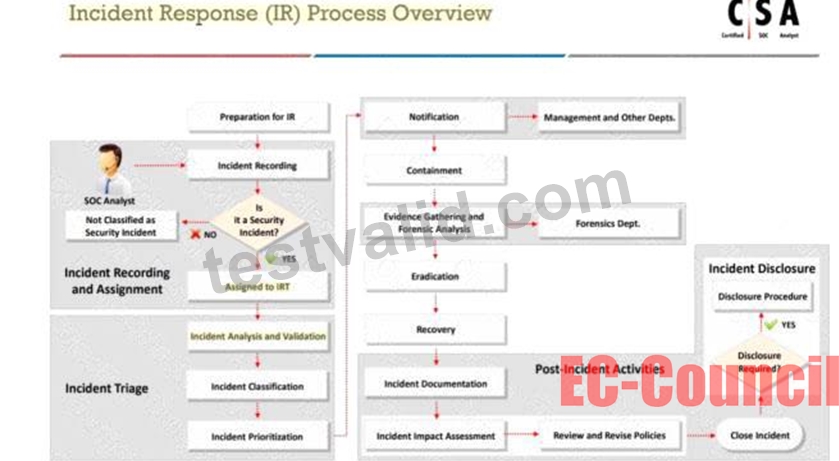
NEW QUESTION # 30
Which of the following attack inundates DHCP servers with fake DHCP requests to exhaust all available IP addresses?
- A. DHCP Port Stealing
- B. DHCP Starvation Attacks
- C. DHCP Spoofing Attack
- D. DHCP Cache Poisoning
Answer: B
Explanation:
A DHCP Starvation Attack is a type of network attack that aims to deplete the pool of available IP addresses on the DHCP server. The attacker floods the DHCP server with fake DHCP DISCOVER messages using spoofed MAC addresses. If successful, the server will exhaust its address space, denying IP configuration to legitimate clients. This can lead to a denial of service (DoS) for new devices attempting to join the network. Additionally, the attacker may set up a rogue DHCP server to issue malicious IP configurations to clients, potentially redirecting traffic or causing further disruption1.
References: The EC-Council SOC Analyst course and study materials cover various network attacks, including DHCP Starvation Attacks. These resources provide insights into the nature of these attacks, their potential impact, and strategies for prevention and mitigation213.
NEW QUESTION # 31
Charline is working as an L2 SOC Analyst. One day, an L1 SOC Analyst escalated an incident to her for further investigation and confirmation. Charline, after a thorough investigation, confirmed the incident and assigned it with an initial priority.
What would be her next action according to the SOC workflow?
- A. She should communicate this incident to the media immediately
- B. She should formally raise a ticket and forward it to the IRT
- C. She should immediately contact the network administrator to solve the problem
- D. She should immediately escalate this issue to the management
Answer: C
NEW QUESTION # 32
Which of the following threat intelligence is used by a SIEM for supplying the analysts with context and
"situational awareness" by using threat actor TTPs, malware campaigns, tools used by threat actors.
1.Strategic threat intelligence
2.Tactical threat intelligence
3.Operational threat intelligence
4.Technical threat intelligence
- A. 2 and 3
- B. 3 and 4
- C. 1 and 3
- D. 1 and 2
Answer: A
NEW QUESTION # 33
John, a SOC analyst, while monitoring and analyzing Apache web server logs, identified an event log matching Regex /(\.|(%|%25)2E)(\.|(%|%25)2E)(\/|(%|%25)2F|\\|(%|%25)5C)/i.
What does this event log indicate?
- A. Directory Traversal Attack
- B. Parameter Tampering Attack
- C. XSS Attack
- D. SQL injection Attack
Answer: A
Explanation:
NEW QUESTION # 34
Which of the following data source can be used to detect the traffic associated with Bad Bot User-Agents?
- A. Web Server Logs
- B. Switch Logs
- C. Router Logs
- D. Windows Event Log
Answer: A
Explanation:
Bad bots are automated software that perform tasks over the internet, which can sometimes be malicious, like scraping data, spamming, or carrying out credential stuffing attacks. To detect the traffic associated with Bad Bot User-Agents, web server logs are the most effective data source. These logs record all the requests made to the web server, including the User-Agent string that identifies the type of client making the request. By analyzing these logs, SOC analysts can identify patterns and behaviors indicative of bad bots, such as high request rates, unusual access patterns, or known malicious User-Agent strings.
References: The EC-Council's Certified SOC Analyst (CSA) program covers the fundamentals of SOC operations, including log management and correlation, which is essential for detecting bad bots. The CSA certification program provides the knowledge required to use various tools and techniques for monitoring and analyzing web server logs for potential threats. For more detailed information, refer to the official EC-Council SOC Analyst study guides and training resources1234.
NEW QUESTION # 35
Rinni, SOC analyst, while monitoring IDS logs detected events shown in the figure below.
What does this event log indicate?
- A. Directory Traversal Attack
- B. Parameter Tampering Attack
- C. SQL Injection Attack
- D. XSS Attack
Answer: B
Explanation:
The event log indicates a Parameter Tampering Attack. This type of attack involves the manipulation of parameters exchanged between the client and the server to alter application data, such as user credentials and permissions, product price and quantity, etc. The IDS log entries showing repeated access to the URL
"/OrderDetail.aspx?id=ORDR-001117" with varying order ID values suggest that the attacker is manipulating the 'id' parameter to potentially access or modify order details unauthorizedly.
References The EC-Council's Certified SOC Analyst (CSA) course materials and study guides discuss various types of cyber attacks, including Parameter Tampering, and their characteristics. Additionally, information on this type of attack can be found in resources provided by the OWASP Foundation1.
NEW QUESTION # 36
An attacker, in an attempt to exploit the vulnerability in the dynamically generated welcome page, inserted code at the end of the company's URL as follows:
http://technosoft.com.com/<script>alert("WARNING: The application has encountered an error");</script>.
Identify the attack demonstrated in the above scenario.
- A. Denial-of-Service Attack
- B. Session Attack
- C. Cross-site Scripting Attack
- D. SQL Injection Attack
Answer: C
Explanation:
Explanation
NEW QUESTION # 37
John as a SOC analyst is worried about the amount of Tor traffic hitting the network. He wants to prepare a dashboard in the SIEM to get a graph to identify the locations from where the TOR traffic is coming.
Which of the following data source will he use to prepare the dashboard?
- A. DNS/ Web Server logs with IP addresses.
- B. IIS/Web Server logs with IP addresses and user agent IPtouseragent resolution.
- C. Apache/ Web Server logs with IP addresses and Host Name.
- D. DHCP/Logs capable of maintaining IP addresses or hostnames with IPtoName resolution.
Answer: D
Explanation:
To monitor and visualize Tor traffic hitting the network, John would need data sources that can provide detailed information about the source IP addresses of incoming traffic, as well as the capability to resolve these IP addresses to more identifiable information such as hostnames or geographical locations. DHCP logs, or other log sources capable of maintaining detailed IP address records and facilitating IP-to-Name resolution, would be suitable for this purpose. This data would allow John to create a dashboard in the SIEM system that maps the source IP addresses of Tor traffic to their corresponding locations or identities, providing insights into where the Tor traffic is originating. While web server logs (options B, C, and D) can provide IP addresses, they might not offer the same level of detail or resolution capabilities as DHCP logs or similar network-level logs for this specific use case.
References:
* "Logging and Log Management: The Authoritative Guide to Understanding the Concepts Surrounding Logging and Log Management" by Anton Chuvakin, Kevin Schmidt, and Chris Phillips.
* "Tor: The Second-Generation Onion Router" by Roger Dingledine, Nick Mathewson, and Paul Syverson.
NEW QUESTION # 38
John, a SOC analyst, while monitoring and analyzing Apache web server logs, identified an event log matching Regex /(\.|(%|%25)2E)(\.|(%|%25)2E)(\/|(%|%25)2F|\\|(%|%25)5C)/i.
What does this event log indicate?
- A. Parameter Tampering Attack
- B. Directory Traversal Attack
- C. XSS Attack
- D. SQL injection Attack
Answer: C
NEW QUESTION # 39
Which of the following service provides phishing protection and content filtering to manage the Internet experience on and off your network with the acceptable use or compliance policies?
- A. Malstrom
- B. I-Blocklist
- C. OpenDNS
- D. Apility.io
Answer: C
Explanation:
OpenDNS provides extensive phishing protection and content filtering services. It operates by enforcing internet use policies on and off the network, ensuring that users adhere to acceptable use and compliance policies. Here's how OpenDNS achieves this:
* Phishing Protection: OpenDNS uses predictive security to anticipate and prevent threats before they can reach the network. It does this by using DNS to enforce security, which is often quicker and more effective than traditional methods.
* Content Filtering: OpenDNS allows the network administrator to block unwanted content categories, thus enforcing compliance with organizational policies. This is done through DNS queries, which are checked against OpenDNS's database to ensure they comply with the set policies.
* Off-Network Protection: OpenDNS's roaming client allows the same level of protection and filtering even when devices are not connected to the company network, ensuring consistent enforcement of policies.
References:
* EC-Council's Certified SOC Analyst (C|SA) program provides training and certification for SOC analysts, covering the fundamentals of SOC operations, including phishing protection and content filtering 1.
* Additional resources and study guides from the EC-Council elaborate on the role of SOC analysts and the tools they use, including services like OpenDNS for maintaining network security and integrity 23.
NEW QUESTION # 40
If the SIEM generates the following four alerts at the same time:
I.Firewall blocking traffic from getting into the network alerts
II.SQL injection attempt alerts
III.Data deletion attempt alerts
IV.Brute-force attempt alerts
Which alert should be given least priority as per effective alert triaging?
- A. I
- B. II
- C. III
- D. IV
Answer: A
NEW QUESTION # 41
What is the process of monitoring and capturing all data packets passing through a given network using different tools?
- A. DNS Footprinting
- B. Port Scanning
- C. Network Sniffing
- D. Network Scanning
Answer: C
NEW QUESTION # 42
......
Check the Free demo of our 312-39 Exam Dumps with 102 Questions: https://www.testvalid.com/312-39-exam-collection.html
Clear your concepts with 312-39 Questions Before Attempting Real exam: https://drive.google.com/open?id=1XN5vY5De1YZCbkCKcOo2nONvUgavf_EQ