

New (2024) Download free PMI-RMP PDF for PMI Practice Tests
100% Free PMI-RMP Files For passing the exam Quickly
Preparation Process
Unfortunately, the PMI does not provide the applicants with any training courses, but we ensure that you can find useful tips, which help you prepare for the PMI-RMP exam. All in all, it is recommended to do the following:
- Take up a formal study course offered by the accredited Authorized Training Partners or PMI chapters;
- Study the Practice Standard for Project Risk Management;
- Download and review the PMI-RMP Handbook;
- Look through the Exam Content Outline;
- Observe the latest edition of ‘A Guide to the Project Management Body of Knowledge’.
All the links for these materials can be found on the official website.
Besides that, the potential candidates can use the other prep resources, such as practice tests, tutorials, videos, and books, which give them all the required knowledge and skills for the PMI-RMP exam.
PMI-RMP (PMI Risk Management Professional) Certification Exam is a certification offered by the Project Management Institute (PMI) to professionals who specialize in risk management. PMI Risk Management Professional certification is designed to evaluate a candidate's knowledge and expertise in identifying, assessing, and managing project risks. PMI-RMP certification holders are recognized for their ability to assess and mitigate risks, which is a valuable skill in project management.
NEW QUESTION # 22
You are the project manager of the NKQ project for your organization. You have completed the quantitative risk analysis process for this portion of the project. What is the only output of the quantitative risk analysis process?
- A. Risk contingency reserve
- B. Probability of reaching project objectives
- C. Risk response
- D. Risk register updates
Answer: D
NEW QUESTION # 23
Your project spans the entire organization. You would like to assess the risk of the project but are worried that some of the managers involved in the project could affect the outcome of any risk identification meeting. Your worry is based on the fact that some employees would not want to publicly identify risk events that could make their supervisors look bad. You would like a method that would allow participants to anonymously identify risk events. What risk identification method could you use?
- A. Isolated pilot groups
- B. Root cause analysis
- C. SWOT analysis
- D. Delphi technique
Answer: D
NEW QUESTION # 24
Ben works as a project manager for the MJH Project. In this project, Ben is preparing to identify stakeholders so he can communicate project requirements, status, and risks. Ben has elected to use a salience model as part of his stakeholder identification process. Which of the following activities best describes a salience model?
- A. Grouping the stakeholders based on their level of authority ("power") and their active involvement ("influence") in the project.
- B. Influence/impact grid, grouping the stakeholders based on their active involvement ("influence") in the project and their ability to affect changes to the project's planning or execution ("impact").
- C. Grouping the stakeholders based on their level of authority ("power") and their level or concern ("interest") regarding the project outcomes.
- D. Describing classes of stakeholders based on their power (ability to impose their will), urgency (need for immediate attention), and legitimacy (their involvement is appropriate).
Answer: D
NEW QUESTION # 25
Which of the following will ultimately determine risk thresholds?
- A. The absolute value of the consequence
- B. The risk appetite of the key stakeholders
- C. The project manager
- D. The practice standard for risk management
Answer: B
NEW QUESTION # 26
An agriculture government agency faces different challenges with farmers and landlords In implementing its ambitious growth strategy. The agency decided to establish an enterprise risk management unit to identify risks, analyze risks, and provide a handbook showing how to handle the surrounding uncertainty.
What should the risk management expert recommend the agency do first to identify risks and develop the handbook?
- A. Conduct meetings, facilitated workshops, and interviews with stakeholders to identify potential risks.
- B. Follow standard risk Identification tools dedicated for agriculture and tailor them to the environment.
- C. Prepare a list of the key resources that will be used to compile a risk management plan.
- D. Hire an agriculture expert who can develop the required handbook and discuss it with the agriculture minister.
Answer: A
Explanation:
Explanation
According to the PMBOK Guide1, risk identification is the process of determining which risks may affect the project and documenting their characteristics. It involves the use of various techniques to gather information from different sources and perspectives, such as stakeholders, experts, historical data, assumptions, and environmental factors. Some of the common techniques for risk identification are meetings, facilitated workshops, interviews, brainstorming, checklists, questionnaires, SWOT analysis, and root cause analysis. These techniques help to elicit the knowledge and opinions of the participants, and to generate a comprehensive list of potential risks that can be further analyzed and prioritized. In this case, the risk management expert should recommend the agency to conduct meetings, facilitated workshops, and interviews with stakeholders to identify potential risks and develop the handbook. This will help to understand the context and objectives of the agency, the expectations and concerns of the farmers and landlords, the challenges and opportunities in the agriculture sector, and the possible sources and impacts of uncertainty. The risk management expert can then use the information gathered from these techniques to create a risk register and a risk management plan, which can form the basis of the handbook. This is part of the Identify Risks process in the PMBOK Guide1. References: 1: A Guide to the Project Management Body of Knowledge (PMBOK Guide) - Sixth Edition Engaging stakeholders through meetings, workshops, and interviews is crucial for risk identification, as it allows the agency to gather diverse perspectives and insights on potential risks. This approach is more effective than relying solely on standard tools or hiring an expert.
NEW QUESTION # 27 
The project sponsor has asked the project manager how much more a P90 will cost. The sponsor has budgeted for a P40. The project values are in thousands.
How much additional funding would the sponsor need to budget for a P90?
- A. US$9,408,000
- B. US$794,000
- C. US$8,495,000
- D. US$913,000
Answer: D
NEW QUESTION # 28
You are the project manager of the NHQ project for your company. You are working with your project team to complete a risk audit. A recent issue that your project team responded to, and management approved, was to increase the project schedule because there was risk surrounding the installation time of a new material. Your logic was that with the expanded schedule there would be time to complete the installation without affecting downstream project activities. What type of risk response is being audited in this scenario?
- A. Lag Time
- B. Mitigation
- C. Parkinson's Law
- D. Avoidance
Answer: D
NEW QUESTION # 29
Nancy is the project manager of the NHH project. She and the project team have identified a significant risk in the project during the qualitative risk analysis process. Bob is familiar with the technology that the risk is affecting and proposes to Nancy a solution to the risk event. Nancy tells Bob that she has noted his response, but the risk really needs to pass through the quantitative risk analysis process before creating responses. Bob disagrees and ensures Nancy that his response is most appropriate for the identified risk. Who is correct in this scenario?
- A. Nancy is correct. All risks of significant probability and impact should pass the quantitative risk analysis process before risk responses are created.
- B. Nancy is correct. Because Nancy is the project manager she can determine the correct procedures for risk analysis and risk responses. In addition, she has noted the risk response that Bob recommends.
- C. Bob is correct. Bob is familiar with the technology and the risk event so his response should be implemented.
- D. Bob is correct. Not all risk events have to pass the quantitative risk analysis process to develop effective risk responses.
Answer: D
Explanation:
Explanation
NEW QUESTION # 30
There are seven risk responses, a project manager can use to address risk events. Which one of the following is a risk response that is appropriate for positive or negative risk events depending on the scenario in the project?
- A. Transference
- B. Acceptance
- C. Avoidance
- D. Sharing
Answer: B
NEW QUESTION # 31
David is the project manager of the NKL Project for his organization. He has been asked to create a proposal for a construction project for a client. David realizes that there are several requirements within the SOW and RFP provided by the client that would eliminate his company from bidding on the construction project. David proposed to management that his organization create a partnership with a competitor so that together they could bid on the construction project and qualify for the customer's requirements. What risk response is David proposing to management?
- A. Transference
- B. Teaming agreement
- C. Exploiting
- D. Sharing
Answer: D
NEW QUESTION # 32
You are the project manager of the NHH project for your company. You and the project team have completed the quantitative risk analysis for your project. During this process you create a contingency reserve based on the risk probability-impact matrix as seen in the figure below.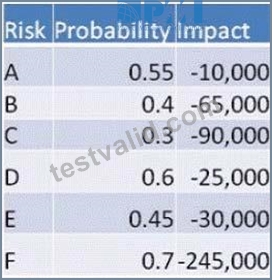
Based on the information in the figure above, what amount would you need to include in your risk contingency fund?
- A. -$258,500
- B. $258,500
- C. -$465,000
- D. $171,500
Answer: B
NEW QUESTION # 33
You are the project manager of the NNH project. In this project you have created a contingency response that the cost performance index should be less than 0.93. The NHH project has a budget at completion of $945,000 and is 45 percent complete - though the project should be 49 percent complete. The project has spent $455,897 to reach the 45 percent complete milestone. What is the project's cost performance index?
- A. -$30,647
- B. 1.06
- C. 0.93
- D. 0.92
Answer: C
NEW QUESTION # 34
A large, land-based infrastructure project has begun. The project makes assumptions about the site conditions and has economic, technical, and environmental constraints What should the project manager do next to determine risk impact of assumptions and constraints?
- A. Add the assumptions and constraints in the project charter.
- B. Add all assumptions and constraints to the risk register.
- C. Add the risk impact of the assumptions in the risk register.
- D. Add the assumptions and constraints to the assumption log.
Answer: D
Explanation:
Explanation
The project manager should add the assumptions and constraints to the assumption log to track and analyze their impact on the project. The assumption log is a project document that records all project assumptions and constraints throughout the project life cycle. (Reference: PMBOK Guide, 6th Edition, p. 89) The project manager should add the assumptions and constraints to the assumption log, which is a project document that records the assumptions and constraints that affect the project scope, schedule, cost, and quality.
The assumption log can help the project manager to identify and analyze the risks that may arise from the validity of the assumptions and the impact of the constraints. The assumption log can also be used as an input for the Identify Risks process, where the project manager can determine the risk impact of the assumptions and constraints and add them to the risk register accordingly. References: PMI, A Guide to the Project Management Body of Knowledge (PMBOK Guide), Sixth Edition, 2017, p. 38, 397.
NEW QUESTION # 35
Your project is an agricultural-based project that deals with plant irrigation systems. You have discovered a byproduct in your project that your organization could use to make a profit. If your organization seizes this opportunity it would be an example of what risk response?
- A. Exploiting
- B. Positive
- C. Opportunistic
- D. Enhancing
Answer: A
NEW QUESTION # 36
You are the project manager of the GHY project for your company. This project has a budget of $543,000 and is expected to last 18 months. In this project, you have identified several risk events and created risk response plans. In what project management process group will you implement risk response plans?
- A. Monitoring and Controlling
- B. In any process group where the risk event resides
- C. Executing
- D. Planning
Answer: A
NEW QUESTION # 37
Rex is the project manager of the BDF Project. This project will last for two years and has a budget of
$2,345,000. Management has instructed Rex that the project must not go over budget as funds are very tight in the organization. During the project planning Rex and the project team discover a positive risk event to save
$75,000. Rex wants to make certain that this risk event happens so which risk response method is most appropriate?
- A. Enhance
- B. Exploit
- C. Mitigation
- D. Share
Answer: B
Explanation:
Explanation
NEW QUESTION # 38
You are the project manager of the HJK Project for your organization. You and the project team have created risk responses for many of the risk events in the project. Where should you document the proposed responses and the current status of all identified risks?
- A. Lessons learned documentation
- B. Stakeholder management strategy
- C. Risk management plan
- D. Risk register
Answer: D
Explanation:
Explanation
NEW QUESTION # 39
You are the project manager of the GGG project. You have completed the risk identification process for the initial phases of your project. As you begin to document the risk events in the risk register what additional information can you associate with the identified risk events?
- A. Risk cost
- B. Risk schedule
- C. Risk potential responses
- D. Risk owner
Answer: C
Explanation:
Explanation/Reference:
NEW QUESTION # 40
Tom works as a project manager for BlueWell Inc. He is determining which risks can affect the project.
Which of the following inputs of the identify risks process is useful in identifying risks, and provides a quantitative assessment of the likely cost to complete the scheduled activities?
- A. Activity duration estimates
- B. Risk management plan
- C. Cost management plan
- D. Activity cost estimates
Answer: D
NEW QUESTION # 41
Fill in the blank with an appropriate phrase.
________are activities that are dangerous to complete and manage such as construction, electrical work, or manufacturing.
- A. Pure risks
Answer: A
NEW QUESTION # 42
You are the project manager of the GGH Project in your company. Your company is structured as a functional organization and you report to the functional manager that you are ready to move onto the quantitative risk analysis process. What things will you need as inputs for the quantitative risk analysis of the project in this scenario?
- A. You will need the risk register, risk management plan, permission from the functional manager, and any relevant organizational process assets.
- B. You will need the risk register, risk management plan, outputs of qualitative risk analysis, and any relevant organizational process assets.
- C. Quantitative risk analysis does not happen through the project manager in a functional structure.
- D. You will need the risk register, risk management plan, cost management plan, schedule management plan, and any relevant organizational process assets.
Answer: D
NEW QUESTION # 43
Project stakeholders can often be risk averse with little to no knowledge of the risk process. How should a risk manager increase stakeholder risk appetite?
- A. Increase the impact of all risks in the risk breakdown structure (RBS)
- B. Exclude risk averse stakeholders from future risk discussions
- C. Explain risk handling and mitigation strategies
- D. Develop a generous probabilistic cash flow model
Answer: C
Explanation:
Explanation
The risk manager should increase stakeholder risk appetite by explaining risk handling and mitigation strategies, which will help stakeholders understand how risks can be managed and reduced, making them more comfortable with the risk process.
The best way to increase stakeholder risk appetite is to explain risk handling and mitigation strategies, which are the actions taken to reduce the probability and/or impact of risks, or to enhance the opportunities. By doing so, the risk manager can help the stakeholders understand how the risks can be managed effectively and efficiently, and how the potential benefits can outweigh the potential costs. This can also increase the stakeholder confidence and trust in the risk process and the project outcomes. The other options are not appropriate ways to increase stakeholder risk appetite. Excluding risk averse stakeholders from future risk discussions can alienate them and create conflicts. Increasing the impact of all risks in the risk breakdown structure (RBS) can exaggerate the risk exposure and create unnecessary fear and anxiety. Developing a generous probabilistic cash flow model can create unrealistic expectations and lead to poor decision making.
References: PMI Risk Management Professional (PMI-RMP) Examination Content Outline and Specifications, page 81. A Guide to the Project Management Body of Knowledge (PMBOK Guide) - Sixth Edition, pages 403-4042.
NEW QUESTION # 44
You are the project manager for your organization. You have identified a risk event you're your organization could manage internally or externally. If you manage the event internally it will cost your project $578,000 and an additional $12,000 per month the solution is in use. A vendor can manage the risk event for you. The vendor will charge $550,000 and $14,500 per month that the solution is in use. How many months will you need to use the solution to pay for the internal solution in comparison to the vendor's solution?
- A. Approximately 13 months
- B. Approximately 15 months
- C. Approximately 11 months
- D. Approximately 8 months
Answer: C
NEW QUESTION # 45
Frank is the project manager of the NHL Project for his company and he is starting the risk identification process for the project. Frank needs to ensure that the correct stakeholders are interviewed as part of risk identification. What document will help Frank to communicate and solicit inputs of the project stakeholders during risk identification?
- A. Project charter
- B. Risk register
- C. Stakeholder register
- D. Requirements management plan
Answer: C
NEW QUESTION # 46
......
PMI-RMP Certification is a globally recognized certification that is designed to validate the knowledge and expertise of professionals in the field of risk management. PMI Risk Management Professional certification is offered by the Project Management Institute (PMI) and is targeted towards professionals who work in areas such as project management, business analysis, and risk management. The PMI-RMP certification exam is a rigorous exam that tests the knowledge and skills of candidates in the areas of risk management, risk identification, risk assessment, risk response, and risk monitoring.
PMI-RMP Premium Exam Engine - Download Free PDF Questions: https://www.testvalid.com/PMI-RMP-exam-collection.html
PMI-RMP Dumps Questions Study Exam Guide : https://drive.google.com/open?id=1V2701ZfKOjhun-Th6ztn8L0K0fboLCkC