

CAS-005 Dumps (2024) Prepare Your Exam With 120 Questions
New CAS-005 Dumps - Real CompTIA Exam Questions
NEW QUESTION # 29
Which of the following is the main reason quantum computing advancements are leading companies and countries to deploy new encryption algorithms?
- A. Perfect forward secrecy will prevent deployment of advanced firewall monitoring techniques
- B. Encryption systems based on large prime numbers will be vulnerable to exploitation
- C. Quantum computers will enable malicious actors to capture IP traffic in real time
- D. Zero Trust security architectures will require homomorphic encryption.
Answer: B
Explanation:
Advancements in quantum computing pose a significant threat to current encryption systems, especially those based on the difficulty of factoring large prime numbers, such as RSA. Quantum computers have the potential to solve these problems exponentially faster than classical computers, making current cryptographic systems vulnerable.
Why Large Prime Numbers are Vulnerable:
* Shor's Algorithm: Quantum computers can use Shor's algorithm to factorize large integers efficiently, which undermines the security of RSA encryption.
* Cryptographic Breakthrough: The ability to quickly factor large prime numbers means that encrypted data, which relies on the hardness of this mathematical problem, can be decrypted.
Other options, while relevant, do not capture the primary reason for the shift towards new encryption algorithms:
* B. Zero Trust security architectures: While important, the shift to homomorphic encryption is not the main driver for new encryption algorithms.
* C. Perfect forward secrecy: It enhances security but is not the main reason for new encryption algorithms.
* D. Real-time IP traffic capture: Quantum computers pose a more significant threat to the underlying cryptographic algorithms than to the real-time capture of traffic.
References:
* CompTIA SecurityX Study Guide
* NIST Special Publication 800-208, "Recommendation for Stateful Hash-Based Signature Schemes"
* "Quantum Computing and Cryptography," MIT Technology Review
NEW QUESTION # 30
A software engineer is creating a CI/CD pipeline to support the development of a web application The DevSecOps team is required to identify syntax errors Which of the following is the most relevant to the DevSecOps team's task'
- A. Runtime application self-protection
- B. Static application security testing
- C. Web application vulnerability scanning
- D. Software composition analysis
Answer: B
Explanation:
Static Application Security Testing (SAST) involves analyzing source code or compiled code for security vulnerabilities without executing the program. This method is well-suited for identifying syntax errors, coding standards violations, and potential security issues early in the development lifecycle.
* A. Static application security testing (SAST): SAST tools analyze the source code to detect syntax errors, vulnerabilities, and other issues before the code is run. This is the most relevant task for the DevSecOps team to identify syntax errors and improve code quality.
* B. Software composition analysis: This focuses on identifying vulnerabilities in open-source components and libraries used in the application but does not address syntax errors directly.
* C. Runtime application self-protection (RASP): RASP involves monitoring and protecting applications during runtime, which does not help in identifying syntax errors during the development phase.
* D. Web application vulnerability scanning: This involves scanning the running application for vulnerabilities but does not address syntax errors in the code.
References:
* CompTIA Security+ Study Guide
* OWASP (Open Web Application Security Project) guidelines on SAST
* NIST SP 800-95, "Guide to Secure Web Services"
Top of Form
Bottom of Form
NEW QUESTION # 31
A security analyst is reviewing the following log:
Which of the following possible events should the security analyst investigate further?
- A. A macro that was prevented from running
- B. A malicious file that was run in this environment
- C. A PDF that exposed sensitive information improperly
- D. A text file containing passwords that were leaked
Answer: D
Explanation:
Based on the log provided, the most concerning event that should be investigated further is the presence of a text file containing passwords that were leaked. Here's why:
* Sensitive Information Exposure: A text file containing passwords represents a significant security risk, as it indicates that sensitive credentials have been exposed in plain text, potentially leading to unauthorized access.
* Immediate Threat: Password leaks can lead to immediate exploitation by attackers, compromising user accounts and sensitive data. This requires urgent investi
NEW QUESTION # 32
A systems administrator wants to reduce the number of failed patch deployments in an organization. The administrator discovers that system owners modify systems or applications in an ad hoc manner. Which of the following is the best way to reduce the number of failed patch deployments?
- A. Quality assurance
- B. Change management
- C. Situational awareness
- D. Compliance tracking
Answer: B
Explanation:
To reduce the number of failed patch deployments, the systems administrator should implement a robust change management process. Change management ensures that all modifications to systems or applications are planned, tested, and approved before deployment. This systematic approach reduces the risk of unplanned changes that can cause patch failures and ensures that patches are deployed in a controlled and predictable manner.
References:
* CompTIA SecurityX Study Guide: Emphasizes the importance of change management in maintaining system integrity and ensuring successful patch deployments.
* ITIL (Information Technology Infrastructure Library) Framework: Provides best practices for change management in IT services.
* "The Phoenix Project" by Gene Kim, Kevin Behr, and George Spafford: Discusses the critical role of change management in IT operations and its impact on system stability and reliability.
NEW QUESTION # 33
A security engineer needs 10 secure the OT environment based on me following requirements
* Isolate the OT network segment
* Restrict Internet access.
* Apply security updates two workstations
* Provide remote access to third-party vendors
Which of the following design strategies should the engineer implement to best meet these requirements?
- A. Enable outbound internet access on the OT firewall to any destination IP address and use the centralized update server for the workstations
- B. Deploy a jump box on the third party network to access the OT environment and provide updates using a physical delivery method on the workstations
- C. Create a staging environment on the OT network for the third-party vendor to access and enable automatic updates on the workstations.
- D. Implement a bastion host in the OT network with security tools in place to monitor access and use a dedicated update server for the workstations.
Answer: D
Explanation:
To secure the Operational Technology (OT) environment based on the given requirements, the best approach is to implement a bastion host in the OT network. The bastion host serves as a secure entry point for remote access, allowing third-party vendors to connect while being monitored by security tools. Using a dedicated update server for workstations ensures that security updates are applied in a controlled manner without direct internet access.
References:
* CompTIA SecurityX Study Guide: Recommends the use of bastion hosts and dedicated update servers for securing OT environments.
* NIST Special Publication 800-82, "Guide to Industrial Control Systems (ICS) Security": Advises on isolating OT networks and using secure remote access methods.
* "Industrial Network Security" by Eric D. Knapp and Joel Thomas Langill: Discusses strategies for securing OT networks, including the use of bastion hosts and update servers.
NEW QUESTION # 34
A security architect wants to develop a baseline of security configurations These configurations automatically will be utilized machine is created Which of the following technologies should the security architect deploy to accomplish this goal?
- A. CMDB
- B. GASB
- C. Ansible
- D. Short
Answer: C
Explanation:
To develop a baseline of security configurations that will be automatically utilized when a machine is created, the security architect should deploy Ansible. Here's why:
* Automation: Ansible is an automation tool that allows for the configuration, management, and deployment of applications and systems. It ensures that security configurations are consistently applied across all new machines.
* Scalability: Ansible can scale to manage thousands of machines, making it suitable for large enterprises that need to maintain consistent security configurations across their infrastructure.
* Compliance: By using Ansible, organizations can enforce compliance with security policies and standards, ensuring that all systems are configured according to best practices.
* References:
* CompTIA Security+ SY0-601 Study Guide by Mike Chapple and David Seidl
* Ansible Documentation: Best Practices
* NIST Special Publication 800-40: Guide to Enterprise Patch Management Technologies
NEW QUESTION # 35
A company receives reports about misconfigurations and vulnerabilities in a third-party hardware device that is part of its released products. Which of the following solutions is the best way for the company to identify possible issues at an earlier stage?
- A. Implementing a monitoring process for the integration between the application and the vendor appliance
- B. Performing regular red-team exercises on the vendor production line
- C. Performing vulnerability tests on each device delivered by the providers
- D. Implementing a proper supply chain risk management program
Answer: D
Explanation:
Addressing misconfigurations and vulnerabilities in third-party hardware requires a comprehensive approach to manage risks throughout the supply chain. Implementing a proper supply chain risk management (SCRM) program is the most effective solution as it encompasses the following:
* Holistic Approach: SCRM considers the entire lifecycle of the product, from initial design through to delivery and deployment. This ensures that risks are identified and managed at every stage.
* Vendor Management: It includes thorough vetting of suppliers and ongoing assessments of their security practices, which can identify and mitigate vulnerabilities early.
* Regular Audits and Assessments: A robust SCRM program involves regular audits and assessments, both internally and with suppliers, to ensure compliance with security standards and best practices.
* Collaboration and Communication: Ensures that there is effective communication and collaboration between the company and its suppliers, leading to faster identification and resolution of issues.
Other options, while beneficial, do not provide the same comprehensive risk management:
* A. Performing vulnerability tests on each device delivered by the providers: While useful, this is reactive and only addresses issues after they have been delivered.
* B. Performing regular red-team exercises on the vendor production line: This can identify vulnerabilities but is not as comprehensive as a full SCRM program.
* C. Implementing a monitoring process for the integration between the application and the vendor appliance: This is important but only covers the integration phase, not the entire supply chain.
References:
* CompTIA SecurityX Study Guide
* NIST Special Publication 800-161, "Supply Chain Risk Management Practices for Federal Information Systems and Organizations"
* ISO/IEC 27036-1:2014, "Information technology - Security techniques - Information security for supplier relationships"
NEW QUESTION # 36
A software development team requires valid data for internal tests. Company regulations, however do not allow the use of this data in cleartext. Which of the following solutions best meet these requirements?
- A. Replacing data with null record
- B. Configuring data hashing
- C. Deploying tokenization
- D. Implementing data obfuscation
Answer: C
Explanation:
Tokenization replaces sensitive data elements with non-sensitive equivalents, called tokens, that can be used within the internal tests. The original data is stored securely and can be retrieved if necessary. This approach allows the software development team to work with data that appears realistic and valid without exposing the actual sensitive information.
Configuring data hashing (Option A) is not suitable for test data as it transforms the data into a fixed-length value that is not usable in the same way as the original data. Replacing data with null records (Option C) is not useful as it does not provide valid data for testing. Data obfuscation (Option D) could be an alternative but might not meet the regulatory requirements as effectively as tokenization.
References:
* CompTIA Security+ Study Guide
* NIST SP 800-57 Part 1 Rev. 5, "Recommendation for Key Management"
* PCI DSS Tokenization Guidelines
NEW QUESTION # 37
You are a security analyst tasked with interpreting an Nmap scan output from company's privileged network.
The company's hardening guidelines indicate the following:
There should be one primary server or service per device.
Only default ports should be used.
Non-secure protocols should be disabled.
INSTRUCTIONS
Using the Nmap output, identify the devices on the network and their roles, and any open ports that should be closed.
For each device found by Nmap, add a device entry to the Devices Discovered list, with the following information:
The IP address of the device
The primary server or service of the device (Note that each IP should by associated with one service/port only) The protocol(s) that should be disabled based on the hardening guidelines (Note that multiple ports may need to be closed to comply with the hardening guidelines) If at any time you would like to bring back the initial state of the simulation, please click the Reset All button.
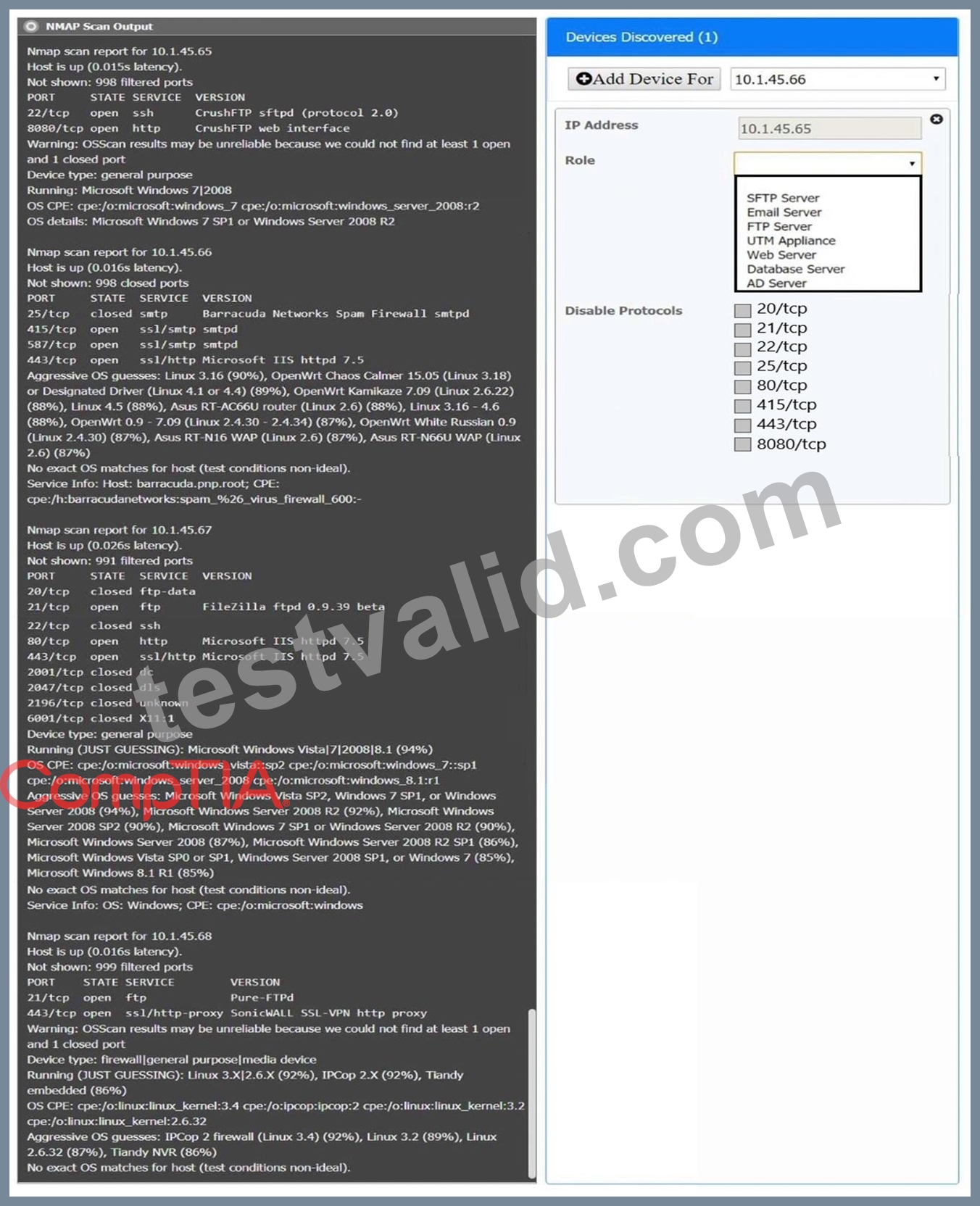
Answer:
Explanation:
See explanation below.
Explanation:
10.1.45.65 SFTP Server Disable 8080
10.1.45.66 Email Server Disable 415 and 443
10.1.45.67 Web Server Disable 21, 80
10.1.45.68 UTM Appliance Disable 21
NEW QUESTION # 38
During a security assessment using an CDR solution, a security engineer generates the following report about the assets in me system:
After five days, the EDR console reports an infection on the host 0WIN23 by a remote access Trojan Which of the following is the most probable cause of the infection?
- A. The EDR has an unknown vulnerability that was exploited by the attacker.
- B. OW1N23 uses a legacy version of Windows that is not supported by the EDR
- C. 0W1N29 spreads the malware through other hosts in the network
- D. LN002 was not supported by the EDR solution and propagates the RAT
Answer: B
Explanation:
OWIN23 is running Windows 7, which is a legacy operating system. Many EDR solutions no longer provide full support for outdated operating systems like Windows 7, which has reached its end of life and is no longer receiving security updates from Microsoft. This makes such systems more vulnerable to infections and attacks, including remote access Trojans (RATs).
* A. OWIN23 uses a legacy version of Windows that is not supported by the EDR: This is the most probable cause because the lack of support means that the EDR solution may not fully protect or monitor this system, making it an easy target for infections.
* B. LN002 was not supported by the EDR solution and propagates the RAT: While LN002 is unmanaged, it is less likely to propagate the RAT to OWIN23 directly without an established vector.
* C. The EDR has an unknown vulnerability that was exploited by the attacker: This is possible but less likely than the lack of support for an outdated OS.
* D. OWIN29 spreads the malware through other hosts in the network: While this could happen, the status indicates OWIN29 is in a bypass mode, which might limit its interactions but does not directly explain the infection on OWIN23.
References:
* CompTIA Security+ Study Guide
* NIST SP 800-53, "Security and Privacy Controls for Information Systems and Organizations"
* Microsoft's Windows 7 End of Support documentation
NEW QUESTION # 39
Recent repents indicate that a software tool is being exploited Attackers were able to bypass user access controls and load a database. A security analyst needs to find the vulnerability and recommend a mitigation.
The analyst generates the following output: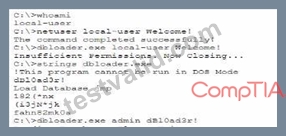
Which of the following would the analyst most likely recommend?
- A. Not allowing users to change their local passwords
- B. Installing appropriate EDR tools to block pass-the-hash attempts
- C. Adding additional time to software development to perform fuzz testing
- D. Removing hard coded credentials from the source code
Answer: D
Explanation:
The output indicates that the software tool contains hard-coded credentials, which attackers can exploit to bypass user access controls and load the database. The most likely recommendation is to remove hard-coded credentials from the source code. Here's why:
* Security Best Practices: Hard-coded credentials are a significant security risk because they can be easily discovered through reverse engineering or simple inspection of the code. Removing them reduces the risk of unauthorized access.
* Credential Management: Credentials should be managed securely using environment variables, secure vaults, or configuration management tools that provide encryption and access controls.
* Mitigation of Exploits: By eliminating hard-coded credentials, the organization can prevent attackers from easily bypassing authentication mechanisms and gaining unauthorized access to sensitive systems.
* References:
* CompTIA Security+ SY0-601 Study Guide by Mike Chapple and David Seidl
* OWASP Top Ten: Insecure Design
* NIST Special Publication 800-53: Security and Privacy Controls for Information Systems and Organizations
NEW QUESTION # 40
A company's help desk is experiencing a large number of calls from the finance department slating access issues to www bank com The security operations center reviewed the following security logs: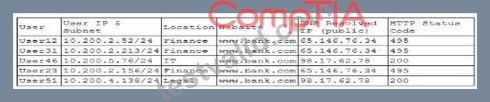
Which of the following is most likely the cause of the issue?
- A. The DNS was set up incorrectly.
- B. The DNS record has been poisoned.
- C. DNS traffic is being sinkholed.
- D. Recursive DNS resolution is failing
Answer: C
Explanation:
Sinkholing, or DNS sinkholing, is a method used to redirect malicious traffic to a safe destination. This technique is often employed by security teams to prevent access to malicious domains by substituting a benign destination IP address.
In the given logs, users from the finance department are accessing www.bank.com and receiving HTTP status code 495. This status code is typically indicative of a client certificate error, which can occur if the DNS traffic is being manipulated or redirected incorrectly. The consistency in receiving the same HTTP status code across different users suggests a systematic issue rather than an isolated incident.
* Recursive DNS resolution failure (A) would generally lead to inability to resolve DNS at all, not to a specific HTTP error.
* DNS poisoning (B) could result in users being directed to malicious sites, but again, would likely result in a different set of errors or unusual activity.
* Incorrect DNS setup (D) would likely cause broader resolution issues rather than targeted errors like the one seen here.
By reviewing the provided data, it is evident that the DNS traffic for www.bank.com is being rerouted improperly, resulting in consistent HTTP 495 errors for the finance department users. Hence, the most likely cause is that the DNS traffic is being sinkholed.
References:
* CompTIA SecurityX study materials on DNS security mechanisms.
* Standard HTTP status codes and their implications.
NEW QUESTION # 41
An organization wants to manage specialized endpoints and needs a solution that provides the ability to
* Centrally manage configurations
* Push policies.
* Remotely wipe devices
* Maintain asset inventory
Which of the following should the organization do to best meet these requirements?
- A. Configure contextual policy management
- B. Implement a mobile device management solution.
- C. Use a configuration management database
- D. Deploy a software asset manager
Answer: B
Explanation:
To meet the requirements of centrally managing configurations, pushing policies, remotely wiping devices, and maintaining an asset inventory, the best solution is to implement a Mobile Device Management (MDM) solution.
MDM Capabilities:
* Central Management: MDM allows administrators to manage the configurations of all devices from a central console.
* Policy Enforcement: MDM solutions enable the push of security policies and updates to ensure compliance across all managed devices.
* Remote Wipe: In case a device is lost or stolen, MDM provides the capability to remotely wipe the device to protect sensitive data.
* Asset Inventory: MDM maintains an up-to-date inventory of all managed devices, including their configurations and installed applications.
Other options do not provide the same comprehensive capabilities required for managing specialized endpoints.
References:
* CompTIA SecurityX Study Guide
* NIST Special Publication 800-124 Revision 1, "Guidelines for Managing the Security of Mobile Devices in the Enterprise"
* "Mobile Device Management Overview," Gartner Research
NEW QUESTION # 42
A vulnerability can on a web server identified the following:
Which of the following actions would most likely eliminate on path decryption attacks? (Select two).
- A. Implementing HIPS rules to identify and block BEAST attack attempts
- B. Adding TLS_ECDHE_ECDSA_WITH_AE3_256_GCMS_HA256
- C. Removing support for CBC-based key exchange and signing algorithms
- D. Restricting cipher suites to only allow TLS_RSA_WITH_AES_128_CBC_SHA
- E. Disallowing cipher suites that use ephemeral modes of operation for key agreement
- F. Increasing the key length to 256 for TLS_RSA_WITH_AES_128_CBC_SHA
Answer: B,C
Explanation:
On-path decryption attacks, such as BEAST (Browser Exploit Against SSL/TLS) and other related vulnerabilities, often exploit weaknesses in the implementation of CBC (Cipher Block Chaining) mode. To mitigate these attacks, the following actions are recommended:
* B. Removing support for CBC-based key exchange and signing algorithms: CBC mode is vulnerable to certain attacks like BEAST. By removing support for CBC-based ciphers, you can eliminate one of the primary vectors for these attacks. Instead, use modern cipher modes like GCM (Galois/Counter Mode) which offer better security properties.
* C. Adding TLS_ECDHE_ECDSA_WITH_AES_256_GCM_SHA256: This cipher suite uses Elliptic Curve Diffie-Hellman Ephemeral (ECDHE) for key exchange, which provides perfect forward secrecy.
It also uses AES in GCM mode, which is not susceptible to the same attacks as CBC. SHA-256 is a strong hash function that ensures data integrity.
References:
* CompTIA Security+ Study Guide
* NIST SP 800-52 Rev. 2, "Guidelines for the Selection, Configuration, and Use of Transport Layer Security (TLS) Implementations"
* OWASP (Open Web Application Security Project) guidelines on cryptography and secure communication
NEW QUESTION # 43
A company recently experienced an incident in which an advanced threat actor was able to shim malicious code against the hardware static of a domain controller The forensic team cryptographically validated that com the underlying firmware of the box and the operating system had not been compromised. However, the attacker was able to exfiltrate information from the server using a steganographic technique within LOAP.
Which of the following is me best way to reduce the risk oi reoccurrence?
- A. Using code signing to verify the source of OS updates
- B. Enforcing allow lists for authorized network pons and protocols
- C. Rolling the cryptographic keys used for hardware security modules
- D. Measuring and attesting to the entire boot chum
Answer: B
Explanation:
The scenario describes a sophisticated attack where the threat actor used steganography within LDAP to exfiltrate data. Given that the hardware and OS firmware were validated and found uncompromised, the attack vector likely exploited a network communication channel. To mitigate such risks, enforcing allow lists for authorized network ports and protocols is the most effective strategy.
Here's why this option is optimal:
* Port and Protocol Restrictions: By creating an allow list, the organization can restrict communications to only those ports and protocols that are necessary for legitimate business operations. This reduces the attack surface by preventing unauthorized or unusual traffic.
* Network Segmentation: Enforcing such rules helps in segmenting the network and ensuring that only approved communications occur, which is critical in preventing data exfiltration methods like steganography.
* Preventing Unauthorized Access: Allow lists ensure that only predefined, trusted connections are allowed, blocking potential paths that attackers could use to infiltrate or exfiltrate data.
Other options, while beneficial in different contexts, are not directly addressing the network communication threat:
* B. Measuring and attesting to the entire boot chain: While this improves system integrity, it doesn't directly mitigate the risk of data exfiltration through network channels.
* C. Rolling the cryptographic keys used for hardware security modules: This is useful for securing data and communications but doesn't directly address the specific method of exfiltration described.
* D. Using code signing to verify the source of OS updates: Ensures updates are from legitimate sources, but it doesn't mitigate the risk of network-based data exfiltration.
References:
* CompTIA SecurityX Study Guide
* NIST Special Publication 800-41, "Guidelines on Firewalls and Firewall Policy"
* CIS Controls Version 8, Control 9: Limitation and Control of Network Ports, Protocols, and Services
NEW QUESTION # 44
All organization is concerned about insider threats from employees who have individual access to encrypted material. Which of the following techniques best addresses this issue?
- A. Key splitting
- B. Account federation with hardware tokens
- C. SSO with MFA
- D. SAE
- E. Sating and hashing
Answer: A
Explanation:
The technique that best addresses the issue of insider threats from employees who have individual access to encrypted material is key splitting. Here's why:
* Key Splitting: Key splitting involves dividing a cryptographic key into multiple parts and distributing these parts among different individuals or systems. This ensures that no single individual has complete access to the key, thereby mitigating the risk of insider threats.
* Increased Security: By requiring multiple parties to combine their key parts to access encrypted material, key splitting provides an additional layer of security. This approach is particularly useful in environments where sensitive data needs to be protected from unauthorized access by insiders.
* Compliance and Best Practices: Key splitting aligns with best practices and regulatory requirements for handling sensitive information, ensuring that access is tightly controlled and monitored.
* References:
* CompTIA Security+ SY0-601 Study Guide by Mike Chapple and David Seidl
* NIST Special Publication 800-57: Recommendation for Key Management
* ISO/IEC 27002:2013: Information Technology - Security Techniques - Code of Practice for Information Security Controls By employing key splitting, organizations can effectively reduce the risk of insider threats and enhance the overall security of encrypted material.
NEW QUESTION # 45
......
Get Ready with CAS-005 Exam Dumps: https://www.testvalid.com/CAS-005-exam-collection.html
Dependable CAS-005 Exam Dumps to Become CompTIA Certified: https://drive.google.com/open?id=14YbBDsPtBiF1SIxoC0egEwntU8Ekm8Ck