

1Z0-829 Free Certification Exam Material from TestValid with 50 Questions
Use Real 1Z0-829 - 100% Cover Real Exam Questions
By passing the Oracle 1Z0-829 certification exam, Java developers can demonstrate their proficiency in Java SE 17 development, which is essential for career advancement and job opportunities. Java SE 17 Developer certification is also a valuable asset for organizations that want to hire skilled Java developers. Oracle certifications are recognized worldwide and are highly respected in the industry, making it a valuable investment for any Java developer. With the 1Z0-829 certification, developers can prove their knowledge and expertise in the latest version of Java and stay up-to-date with the latest industry trends and developments.
NEW QUESTION # 23
Given the code fragments:
Which action prints Wagon : 200?
- A. At Line n1, implement the java.io.AutoCloseable interface
- B. At Line n3, replace Car with LuxurayCar.
- C. At line n1, implement the java.io, Serializable interface.
- D. At line n2, in the main method signature, add throws IOException, ClassCastException.
- E. At line n2, in the main method signature, add throws IoException, ClassNotFoundException.
- F. At line n3, replace readObject (0 with readLine().
Answer: E
Explanation:
Explanation
The code fragment is trying to read an object from a file using the ObjectInputStream class. This class throws an IOException and a ClassNotFoundException. To handle these exceptions, the main method signature should declare that it throws these exceptions. Otherwise, the code will not compile. If the main method throws these exceptions, the code will print Wagon : 200, which is the result of calling the toString method of the LuxuryCar object that was written to the file. References: ObjectInputStream (Java SE 17 & JDK 17) - Oracle, ObjectOutputStream (Java SE 17 & JDK 17) - Oracle
NEW QUESTION # 24
Given:
What is the result?
- A. runsruns
- B. flipsruns
- C. flipsflips
- D. Compilation fails
- E. runsflips
Answer: D
Explanation:
Explanation
The code fragment will fail to compile because the play method in the Dog class is declared as private, which means that it cannot be accessed from outside the class. The main method is trying to call the play method on a Dog object, which is not allowed. Therefore, the code fragment will produce a compilation error.
NEW QUESTION # 25
Which statement is true?
- A. A thread in waiting state must handle InterrupedException.
- B. After the timed wait expires, the waited thread moves to the terminated state.
- C. thread in waiting state consumes CPU cycles.
- D. IllegalStateException is thrown if a thread in waiting state is moved back to runnable.
Answer: A
Explanation:
Explanation
A thread in waiting state is waiting for another thread to perform a particular action, such as calling notify() or notifyAll() on a shared object, or terminating a joined thread. A thread in waiting state can be interrupted by another thread, which will cause the waiting thread to throw an InterruptedException and return to the runnable state. Therefore, a thread in waiting state must handle InterruptedException, either by catching it or declaring it in the throws clause. References: Thread.State (Java SE 17 & JDK 17), [Thread (Java SE 17 & JDK 17)]
NEW QUESTION # 26
Daylight Saving Time (DST) is the practice of advancing clocks at the start of spring by one hour and adjusting them backward by one hour in autumn.
Considering that in 2021, DST in Chicago (Illinois) ended on November 7th at 2 AM, and given the fragment:
What is the output?
- A. true
true - B. False
false - C. false
true - D. true
false
Answer: D
Explanation:
Explanation
The answer is A because the code fragment uses the ZoneId and ZonedDateTime classes to create two date-time objects with the same local date-time but different zone offsets. The ZoneId class represents a time-zone ID, such as America/Chicago, and the ZonedDateTime class represents a date-time with a time-zone in the ISO-8601 calendar system. The code fragment creates two ZonedDateTime objects with the same local date-time of 2021-11-07T01:30, but different zone IDs of America/Chicago and UTC. The code fragment then compares the two objects using the equals and isEqual methods.
The equals method compares the state of two objects for equality. In this case, it compares the local date-time, zone offset, and zone ID of the two ZonedDateTime objects. Since the zone offsets and zone IDs are different, the equals method returns false.
The isEqual method compares the instant of two temporal objects for equality. In this case, it compares the instant of the two ZonedDateTime objects, which is derived from the local date-time and zone offset. Since DST in Chicago ended on November 7th at 2 AM in 2021, the local date-time of 2021-11-07T01:30 in America/Chicago corresponds to the same instant as 2021-11-07T06:30 in UTC. Therefore, the isEqual method returns true.
Hence, the output is true false. References:
Oracle Certified Professional: Java SE 17 Developer
Java SE 17 Developer
OCP Oracle Certified Professional Java SE 17 Developer Study Guide
ZoneId (Java Platform SE 8 )
ZonedDateTime (Java Platform SE 8 )
Time Zone & Clock Changes in Chicago, Illinois, USA
Daylight Saving Time Changes 2023 in Chicago, USA
NEW QUESTION # 27
Given the directory structure: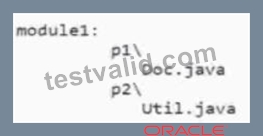
Given the definition of the Doc class:
Which two are valid definition of the wordDoc class?
- A. Package p1;
Public final class WordDoc extends Doc () - B. Package p1, p2;
Public sealed class WordDoc extends Doc () - C. Package p1,
non-sealed abstract class WordDoc extends Doc () - D. Package p1;
Public non-sealed class wordDoc extends Doc () - E. Package p1;
Public class wordDoc extends Doc () - F. Package p1, p2;
Public non-sealed class WordDoc extends Doc ()
Answer: A,D
Explanation:
The correct answer is A and F because the wordDoc class must be a non-sealed class or a final class to extend the sealed Doc class. Option B is incorrect because the wordDoc class must be non-sealed or final. Option C is incorrect because the wordDoc class cannot be in a different package than the Doc class. Option D is incorrect because the wordDoc class cannot be a sealed class. Option E is incorrect because the wordDoc class cannot be an abstract class. Reference: Oracle Certified Professional: Java SE 17 Developer, 3 Sealed Classes - Oracle Help Center
NEW QUESTION # 28
Given: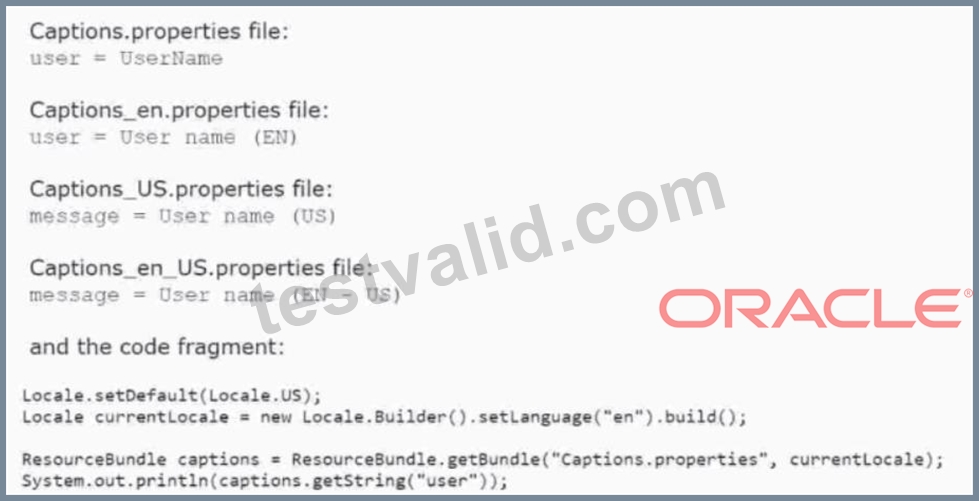
What is the result?
- A. User name (US)
- B. UserName
- C. The program throws a MissingResourceException.
- D. User name (EN)
- E. User name (EN - US)
Answer: C
Explanation:
Explanation
The answer is B because the code fragment contains a logical error that causes a MissingResourceException at runtime. The code fragment tries to load a resource bundle with the base name "Captions.properties" and the locale "en_US". However, there is no such resource bundle available in the classpath. The available resource bundles are:
Captions.properties
Captions_en.properties
Captions_US.properties
Captions_en_US.properties
The ResourceBundle class follows a fallback mechanism to find the best matching resource bundle for a given locale. It first tries to find the resource bundle with the exact locale, then it tries to find the resource bundle with the same language and script, then it tries to find the resource bundle with the same language, and finally it tries to find the default resource bundle with no locale. If none of these resource bundles are found, it throws a MissingResourceException.
In this case, the code fragment is looking for a resource bundle with the base name "Captions.properties" and the locale "en_US". The ResourceBundle class will try to find the following resource bundles in order:
Captions.properties_en_US
Captions.properties_en
Captions.properties
However, none of these resource bundles exist in the classpath. Therefore, the ResourceBundle class will throw a MissingResourceException.
To fix this error, the code fragment should use the correct base name of the resource bundle family, which is
"Captions" without the ".properties" extension. For example:
ResourceBundle captions = ResourceBundle.getBundle("Captions", currentLocale); This will load the appropriate resource bundle for the current locale, which is "Captions_en_US.properties" in this case. References:
Oracle Certified Professional: Java SE 17 Developer
Java SE 17 Developer
OCP Oracle Certified Professional Java SE 17 Developer Study Guide
ResourceBundle (Java Platform SE 8 )
About the ResourceBundle Class (The Java™ Tutorials > Internationalization)
NEW QUESTION # 29
Given the code fragment:
What is the result?
- A. Dog
Dog - B. A NullPointerException is thrown
Cat
Cat - C. Cat
null - D. Cat
Dog
Answer: C
Explanation:
The answer is E because the code fragment creates a new Pet object with the name "Dog" and assigns it to the variable p. Then, it assigns p to p1. Next, it changes the name of p1 to "Cat". Then, it assigns p1 to p. Finally, it sets p to null and prints the name of p and p1. The output will be "Cat" and "null" because p is set to null and p1 still points to the Pet object with the name "Cat".
NEW QUESTION # 30
Given the product class:
And the shop class:
What is the result?
- A. Cookie 3.99 2.99
- B. Cookie 0.0 2.99
- C. An exception is produced at runtime
- D. Cookie 0.0 0.0
- E. Compilation fails
- F. Cookie 2.99 2.99
Answer: E
Explanation:
Explanation
The code fragment will fail to compile because the readObject method in the Product class is missing the
@Override annotation. The readObject method is a special method that is used to customize the deserialization process of an object. It must be declared as private, have no return type, and take a single parameter of type ObjectInputStream. It must also be annotated with @Override to indicate that it overrides the default behavior of the ObjectInputStream class. Without the @Override annotation, the compiler will treat the readObject method as a normal method and not as a deserialization hook. Therefore, the code fragment will produce a compilation error. References: Object Serialization - Oracle, [ObjectInputStream (Java SE 17 & JDK 17) - Oracle]
NEW QUESTION # 31
Given:
Which two method invocation execute?
- A. iFace mucloassObj = new Myc (); myClassObj.m4();
- B. IFace .,4():
- C. IFace myclassobj = new Myc (); myclassObj.m3 ();
- D. IFace.m2();
- E. Ifnce.m3 ();
- F. new MyC() .m2 ();
Answer: B,F
Explanation:
Explanation
The code given is an interface and a class that implements the interface. The interface has three methods, m1(), m2(), and m3(). The class has one method, m1(). The only two method invocations that will execute are D and E.
D is a call to the m2() method in the class, and E is a call to the m3() method in the interface. References:
https://education.oracle.com/products/trackp_OCPJSE17, 3, 4, 5
NEW QUESTION # 32
Given:
What is the result?
- A. Mb
MC - B. Mb
- C. MA
- D. mA
- E. Mb
Answer: D
Explanation:
The code snippet is an example of Java SE 17 code. The code is checking if the object is an instance of class C and if it is, it will print "mC". If it is not an instance of class C, it will print "mA". In this case, the object is not an instance of class C, so the output will be "mA". Reference: Pattern Matching for instanceof - Oracle Help Center
NEW QUESTION # 33
Given the code fragment:
Which code fragment invokes all callable objects in the workers set?
- A.

- B.

- C.

- D.

Answer: C
Explanation:
Explanation
The code fragment in Option C invokes all callable objects in the workers set by using the ExecutorService's invokeAll() method. This method takes a collection of Callable objects and returns a list of Future objects representing the results of the tasks. The other options are incorrect because they either use the wrong method (invokeAny() or submit()) or have syntax errors (missing parentheses or semicolons). References: AbstractExecutorService (Java SE 17 & JDK 17) - Oracle
NEW QUESTION # 34
Given: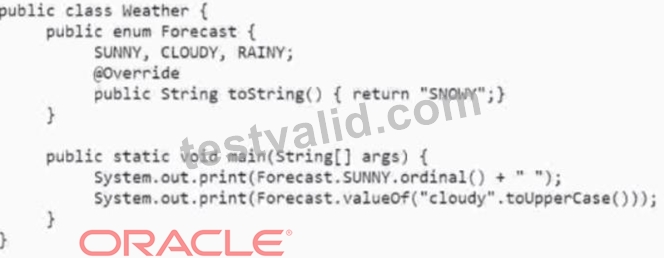
What is the result?
- A. 0 Snowy
- B. 1 RAINY
- C. Compilation fails
- D. 1 Snowy
- E. 0 CLOUDY
Answer: A
Explanation:
Explanation
The code is defining an enum class called Forecast with three values: SUNNY, CLOUDY, and RAINY. The toString() method is overridden to always return "SNOWY". In the main method, the ordinal value of SUNNY is printed, which is 0, followed by the value of CLOUDY converted to uppercase, which is "CLOUDY".
However, since the toString() method of Forecast returns "SNOWY" regardless of the actual value, the output will be "0 SNOWY". References: Enum (Java SE 17 & JDK 17), Enum.EnumDesc (Java SE 17 & JDK 17)
NEW QUESTION # 35
Given:
Which statement is true while the program prints GC?
- A. None of the objects are eligible for garbage collection.
- B. Only one of the objects previously referenced by t1 is eligible for garbage collection.
- C. Only the object referenced by t2 is eligible for garbage collection.
- D. Both the objects previously referenced by t1 are eligible for garbage collection.
Answer: D
NEW QUESTION # 36
Given the code fragment: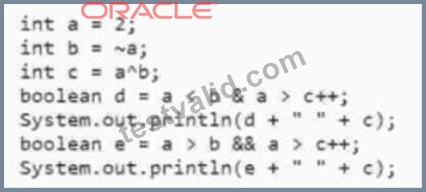
What is the result?
- A. false 1
false 2 - B. false 1
ture 2 - C. falase 0
true 1 - D. true 1
false 2
Answer: D
Explanation:
Explanation
The code fragment is comparing the values of a, b, and c using the < and > operators. The first comparison, d, is checking if a is less than b and greater than c. Since a is equal to 2, b is equal to -2, and c is equal to -4, this comparison will evaluate to true. The second comparison, e, is checking if a is greater than b and a is greater than c. Since a is equal to 2, b is equal to -2, and c is equal to -4, this comparison will evaluate to false.
Therefore, the result will be true 1 false 2. References: Operators (The Java™ Tutorials > Learning the Java Language - Oracle
NEW QUESTION # 37
Given:
What is the result?
- A. B A D
- B. D D D
- C. B A C
- D. D A D
Answer: A
Explanation:
The answer is C because the code demonstrates the concept of method overloading and type conversion in Java. Method overloading allows different methods to have the same name but different parameters. Type conversion allows values of one data type to be assigned to another data type, either automatically or explicitly. In the code, the class Test has four methods named sum, each with different parameter types: int, float, and double. The main method creates an instance of Test and calls the sum method with different arguments. The compiler will choose the most specific method that matches the arguments, based on the following rules:
If there is an exact match between the argument types and the parameter types, that method is chosen.
If there is no exact match, but there is a method with compatible parameter types, that method is chosen. Compatible types are those that can be converted from one to another automatically, such as int to long or float to double.
If there is more than one method with compatible parameter types, the most specific method is chosen. The most specific method is the one whose parameter types are closest to the argument types in terms of size or precision.
In the code, the following method calls are made:
test.sum(10, 10.5) -> This matches the sum(int a, float b) method exactly, so it is chosen. The result is 20.5, which is converted to int and printed as 20 (B).
test.sum(10) -> This does not match any method exactly, but it matches the sum(double a) method with compatible types, as int can be converted to double automatically. The result is 10.0, which is printed as 10 (A).
test.sum(10.5, 10) -> This does not match any method exactly, but it matches two methods with compatible types: sum(float a, float b) and sum(double a, double b). The latter is more specific, as double is closer to the argument types than float. The result is 20.5, which is printed as 20 (D).
Therefore, the output is B A D. Reference:
Oracle Certified Professional: Java SE 17 Developer
Java SE 17 Developer
OCP Oracle Certified Professional Java SE 17 Developer Study Guide
Method Overloading in Java
Type conversion in Java with Examples
Java Method Overloading with automatic type conversions
NEW QUESTION # 38
Which statement is true?
- A. A thread in waiting state must handle InterrupedException.
- B. After the timed wait expires, the waited thread moves to the terminated state.
- C. thread in waiting state consumes CPU cycles.
- D. IllegalStateException is thrown if a thread in waiting state is moved back to runnable.
Answer: A
Explanation:
A thread in waiting state is waiting for another thread to perform a particular action, such as calling notify() or notifyAll() on a shared object, or terminating a joined thread. A thread in waiting state can be interrupted by another thread, which will cause the waiting thread to throw an InterruptedException and return to the runnable state. Therefore, a thread in waiting state must handle InterruptedException, either by catching it or declaring it in the throws clause. Reference: Thread.State (Java SE 17 & JDK 17), [Thread (Java SE 17 & JDK 17)]
NEW QUESTION # 39
......
Dumps Brief Outline Of The 1Z0-829 Exam: https://www.testvalid.com/1Z0-829-exam-collection.html
1Z0-829 Training & Certification Get Latest Oracle Java: https://drive.google.com/open?id=1rkm2b7krnqUBYhyBYowJLJPDPF8Fs1T-