

Pass Cisco 350-401 exam questions - convert Test Engine to PDF
Pass Your 350-401 Exam Easily - Real 350-401 Practice Dump Updated Oct 25, 2025
NEW QUESTION # 169
Which two statements about EIGRP load balancing are true? (Choose two.)
- A. Any path in the EIGRP topology table can be used for unequal-cost load balancing.
- B. A path can be used for load balancing only if it is a feasible successor.
- C. Cisco Express Forwarding is required to load-balance across interfaces.
- D. EIGRP supports 6 unequal-cost paths.
- E. EIGRP supports unequal-cost paths by default.
Answer: B,D
Explanation:
EIGRP provides a mechanism to load balance over unequal cost paths (or called unequal cost load balancing) through the "variance" command. In other words, EIGRP will install all paths with metric < variance * best_metric into the local routing table, provided that it meets the feasibility condition to prevent routing loop. The path that meets this requirement is called a feasible successor. If a path is not a feasible successor, it is not used in load balancing.
Note: The feasibility condition states that, the Advertised Distance (AD) of a route must be lower than the feasible distance of the current successor route.
NEW QUESTION # 170
Refer to the exhibit.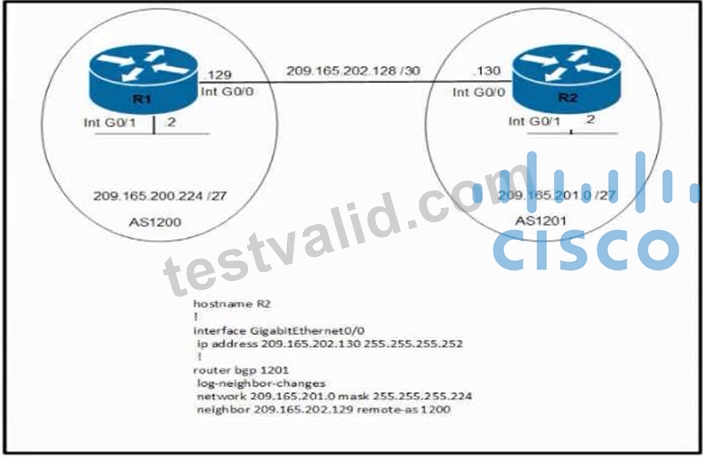
Which command set must be applied on R1 to establish a BGP neighborship with R2 and to allow communication from R1 to reach the networks?
- A.

- B.

- C.

- D.

Answer: C
NEW QUESTION # 171
Refer to the exhibit.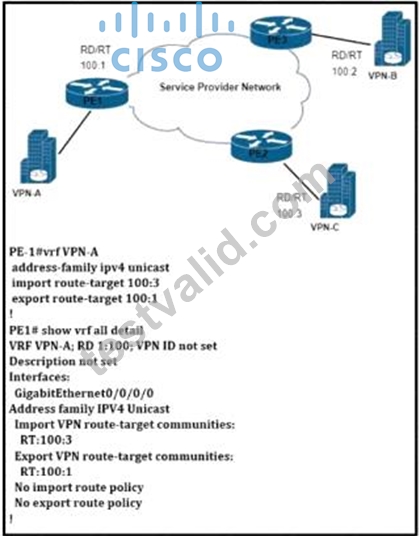
VPN-A sends point-to-point traffic to VPN-B and receives traffic only from VPN-C VPN-B sends point-to-point traffic to VPN-C and receives traffic only from VPN-A Which configuration is applied?
- A.
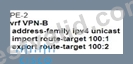
- B.
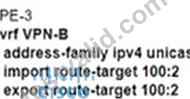
- C.
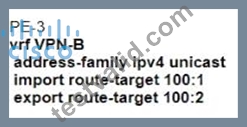
- D.
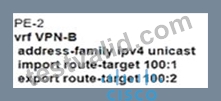
Answer: D
Explanation:
The correct configuration for the scenario described would involve setting up VPN-A to send traffic to VPN-B and receive from VPN-C, and VPN-B to send to VPN-C and receive from VPN-A. This can be achieved through proper routing and forwarding configurations using technologies such as MPLS L3VPNs, which allow for the segregation of different VPN traffic over a shared network infrastructure. The configuration would ensure that the correct paths are established for traffic flow between the VPNs as specified. References := The Implementing and Operating Cisco Service Provider Network Core Technologies (SPCOR) course provides a deep dive into Service Provider technologies including core architecture, services, networking, automation, quality of services, security, and network assurance. It covers topics such as MPLS VPNs, which are relevant to the question1
NEW QUESTION # 172
Refer the exhibit.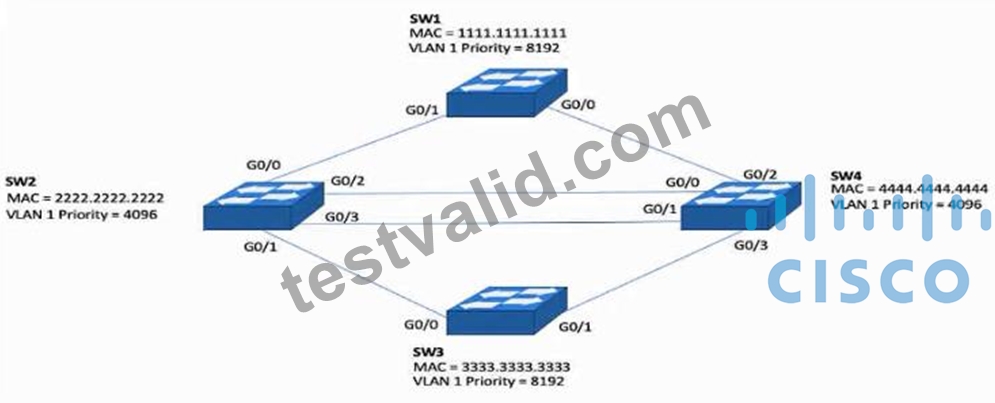
Which configuration elects SW4 as the root bridge for VLAN 1 and puts G0/2 on SW2 into a blocking state?
A)
B)
C)
D)
- A. Option D
- B. Option A
- C. Option C
- D. Option B
Answer: D
NEW QUESTION # 173
Refer to the exhibit.
What is the JSON syntax that is formed the data?
- A. Name', 'Bob Johson,' 'Age', 75, 'Alive', true, 'favourite Foods' 'Cereal', 'Mustard', 'Onions'}
- B. Name'', ''Bob'' Johson'', ''Age'', 75, ''Alive'', true, ''favourite Foods'', [''Cereal, ''Mustard'', Onions''}}
- C. Name: Bob, Johson, Age: 75, Alive: true, Favourite Foods. [Cereal, ''Mustard'', ''Onions}}
- D. Name''. ''Bob Johson'', ''Age'': Seventyfive, ''Alive'' true, ''favourite Foods'' ,[Cereal'' ''Mustard''
''Onions''}}
Answer: A
NEW QUESTION # 174
Which method does Cisco DNA Center use to allow management of non-Cisco devices through southbound protocols?
- A. It creates device packs through the use of an SDK
- B. It uses an API call to interrogate the devices and register the returned data.
- C. It imports available APIs for the non-Cisco device in a CSV format.
- D. It obtains MIBs from each vendor that details the APIs available.
Answer: A
Explanation:
Cisco DNA Center allows customers to manage their non-Cisco devices through the use of a Software Development Kit (SDK) that can be used to create Device Packages for third-party devices.
Reference:
https://developer.cisco.com/docs/dna-center/#!cisco-dna-center-platform-overview/multivendor-support-southbo
NEW QUESTION # 175
What does the Cisco DNA REST response indicate?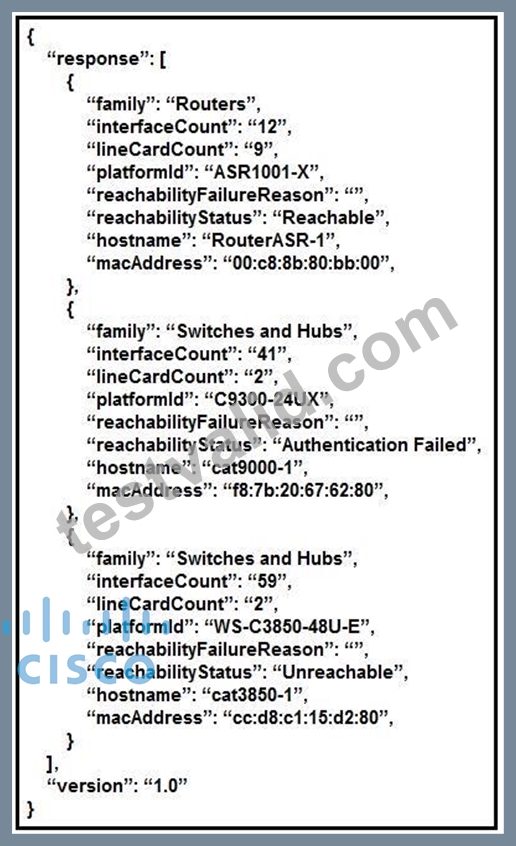
- A. Cisco DNA Center has the incorrect credentials for cat9000-1
- B. Cisco DNA Center has the Incorrect credentials for RouterASR-1
- C. Cisco DNA Center is unable to communicate with cat9000-1
- D. Cisco DNA Center has the Incorrect credentials for cat3850-1
Answer: A
NEW QUESTION # 176
Which outbound access list, applied to the WAN interface of a router, permits all traffic except for http traffic sourced from the workstation with IP address 10.10.10.1?
A)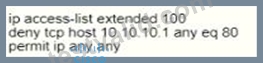
B)
C)
D)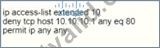
- A. Option D
- B. Option B
- C. Option C
- D. Option A
Answer: D
NEW QUESTION # 177
Which HTTP status code is the correct response for a request with an incorrect password applied to a REST API session?
- A. HTTP Status Code 302
- B. HTTP Status Code 401
- C. HTTP Status Code 200
- D. HTTP Status Code: 504
Answer: B
NEW QUESTION # 178
Drag and drop the characteristics from the left onto the technology types on the right.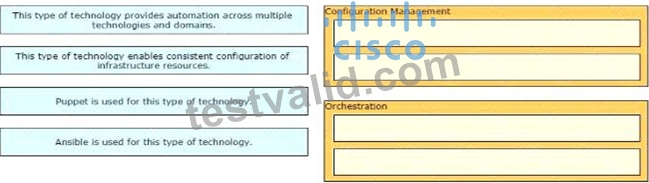
Answer:
Explanation: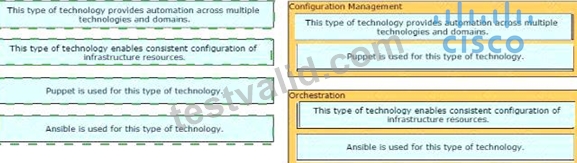
Explanation
Orchestration
Orchestration means arranging or coordinating multiple systems. It's also used to mean "running the same tasks on a bunch of servers at once, but not necessarily all of them." Configuration Management Config Management is part of provisioning. Basically, that's using a tool like Chef, Puppet or Ansible to configure our server. "Provisioning" often implies it's the first time we do it. Config management usually happens repeatedly.
Configuration management (CM) is a systems engineering process for establishing and maintaining consistency of a product's performance, functional, and physical attributes with its requirements, design, and operational information throughout its life Configuration management is all about bringing consistency in the infrastructure.
Configuration Orchestration vs Configuration Management
The first thing that should be clarified is the difference between "configuration orchestration" and
"configuration management" tools, both of which are considered IaC tools and are included on this list.
Configuration orchestration tools, which include Terraform and AWS CloudFormation, are designed to automate the deployment of servers and other infrastructure. Configuration management tools like Chef, Puppet, and the others on this list help configure the software and systems on this infrastructure that has already been provisioned.
NEW QUESTION # 179
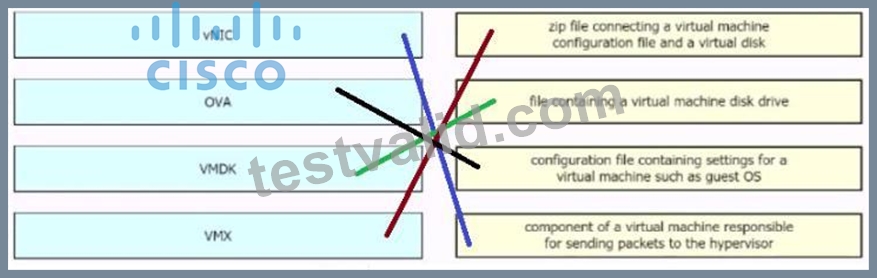
Drag and drop the virtual components from the left onto their deceptions on the right.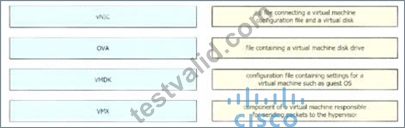
Answer:
Explanation: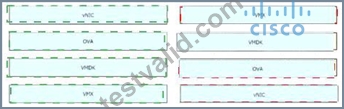
NEW QUESTION # 180
What is a characteristic of a WLC that is in master controller mode?
- A. The master controller is responsible for load balancing all connecting clients to other controllers.
- B. All wireless LAN controllers are managed by the master controller.
- C. Configuration on the master controller is executed on all wireless LAN controllers.
- D. All new APs that join the WLAN are assigned to the master controller.
Answer: D
Explanation:
Reference:
When should I use the master controller mode on a WLC? - When there is a master controller enabled, all newly added access points with no primary, secondary, or tertiary controllers assigned associate with the master controller on the same subnet.
NEW QUESTION # 181
Which QoS mechanism will prevent a decrease in TCP performance?
- A. Rate-Limit
- B. Policer
- C. Fair-Queue
- D. LLQ
- E. Shaper
- F. WRED
Answer: F
Explanation:
Explanation
Weighted Random Early Detection (WRED) is just a congestion avoidance mechanism. WRED
drops packets selectively based on IP precedence. Edge routers assign IP precedences to packets
as they enter the network. When a packet arrives, the following events occur:
The average queue size is calculated.
2. If the average is less than the minimum queue threshold, the arriving packet is queued.
3. If the average is between the minimum queue threshold for that type of traffic and the
maximum threshold for the interface, the packet is either dropped or queued, depending on the
packet drop probability for that type of traffic.
4. If the average queue size is greater than the maximum threshold, the packet is dropped.
WRED reduces the chances of tail drop (when the queue is full, the packet is dropped) by
selectively dropping packets when the output interface begins to show signs of congestion (thus it
can mitigate congestion by preventing the queue from filling up). By dropping some packets early
rather than waiting until the queue is full, WRED avoids dropping large numbers of packets at
once and minimizes the chances of global synchronization. Thus, WRED allows the transmission
line to be used fully at all times.
WRED generally drops packets selectively based on IP precedence. Packets with a higher IP
precedence are less likely to be dropped than packets with a lower precedence. Thus, the higher
the priority of a packet, the higher the probability that the packet will be delivered.
Reference:
mt/qos-conavd-15-mt-book/qos-conavd-cfg-wred.html
WRED is only useful when the bulk of the traffic is TCP/IP traffic. With TCP, dropped packets
indicate congestion, so the packet source will reduce its transmission rate. With other protocols,
packet sources may not respond or may resend dropped packets at the same rate. Thus, dropping
packets does not decrease congestion.
16/qos-conavd-xe-16-book/qos-conavd-oview.html
Note: Global synchronization occurs when multiple TCP hosts reduce their transmission rates in
response to congestion. But when congestion is reduced, TCP hosts try to increase their
transmission rates again simultaneously (known as slow-start algorithm), which causes another
congestion. Global synchronization produces this graph: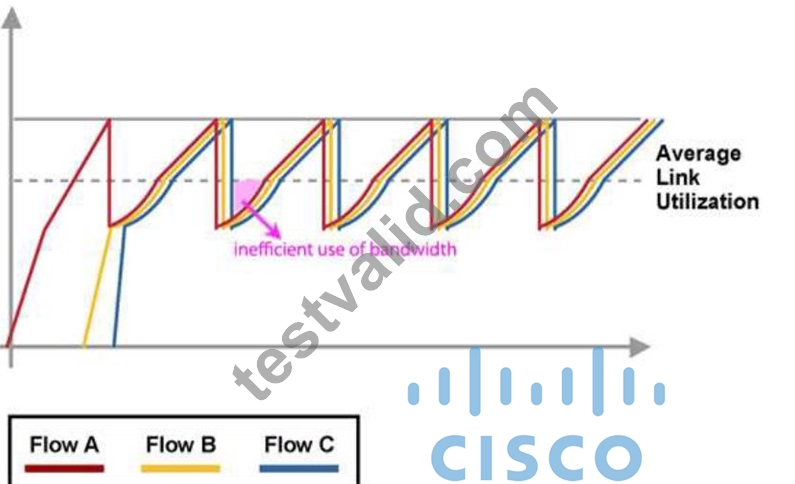
NEW QUESTION # 182
Refer the exhibit.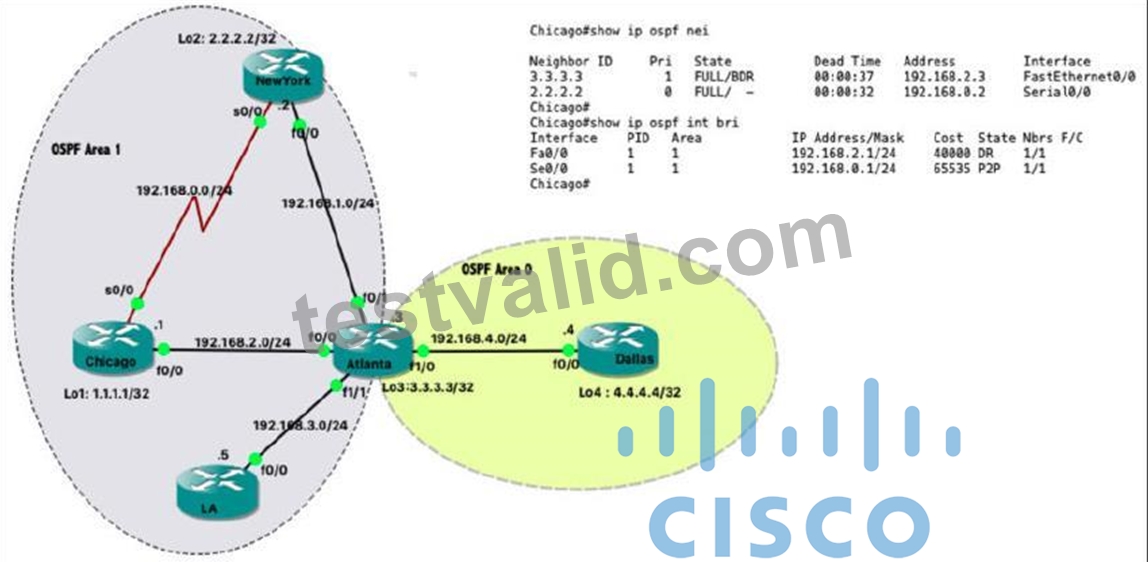
Which router is the designated router on the segment 192.168.0.0/24?
- A. This segment has no designated router because it is a p2p network type.
- B. Router NewYork because it has a higher router ID
- C. Router Chicago because it has a lower router ID
- D. This segment has no designated router because it is a nonbroadcast network type.
Answer: A
NEW QUESTION # 183
Refer to the exhibit.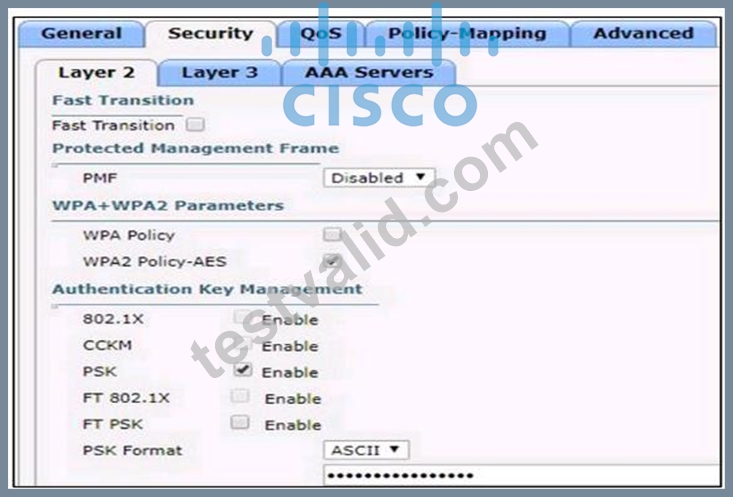
Based on the configuration in this WLAN security setting, Which method can a client use to authenticate to the network?
- A. text string
- B. username and password
- C. RADIUS token
- D. certificate
Answer: A
NEW QUESTION # 184
Drag and Drop Question
Please drag and drop the options provided in the left to configure NTP in client mode.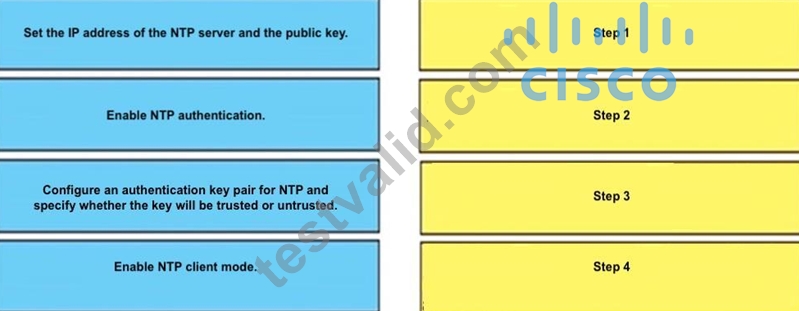
Answer:
Explanation: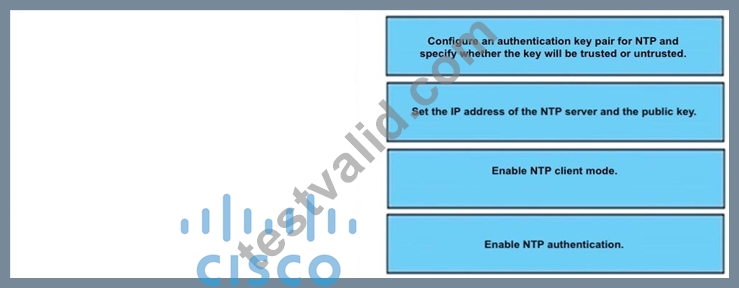
NEW QUESTION # 185 
Refer to the exhibit. An engineer constructs an EEM applet to prevent anyone from entering configuration mode on a switch. Which snippet is required to complete the EEM applet?
- A. sync no skip no
- B. sync yes skip no
- C. sync no skip yes
- D. sync yes skip yes
Answer: C
NEW QUESTION # 186
Which feature must be configured to allow packet capture over Layer 3 infrastructure'?
- A. VSPAN
- B. ERSPAN
- C. RSPAN
- D. IPSPAN
Answer: B
Explanation:
Encapsulated remote SPAN (ERSPAN): encapsulated Remote SPAN (ERSPAN), as the name says,
brings generic routing encapsulation (GRE) for all captured traffic and allows it to be extended
across Layer 3 domains.
NEW QUESTION # 187 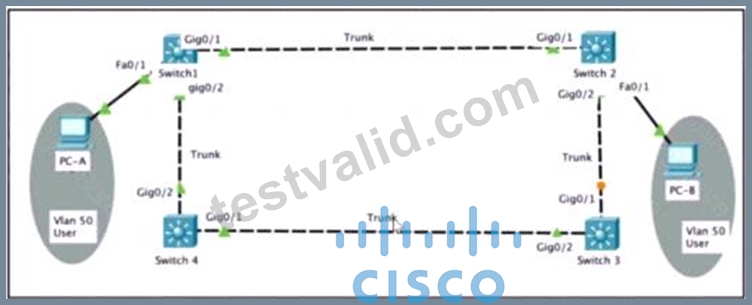
Refer to the exhibit. Rapid PVST+ is enabled on all switches. Which command set must be configured on switch1 to achieve the following results on port fa0/1?
- A.

- B.

- C.

- D.

Answer: D
NEW QUESTION # 188
What are two device roles in Cisco SD-Access fabric? (Choose two.)
- A. access switch
- B. vBond controller
- C. edge node
- D. core switch
- E. border node
Answer: C,E
Explanation:
Explanation
There are five basic device roles in the fabric overlay:
+ Control plane node: This node contains the settings, protocols, and mapping tables to provide the endpoint-to-location (EID-to-RLOC) mapping system for the fabric overlay.
+ Fabric border node: This fabric device (for example, core layer device) connects external Layer 3 networks to the SDA fabric.
+ Fabric edge node: This fabric device (for example, access or distribution layer device) connects wired endpoints to the SDA fabric.
+ Fabric WLAN controller (WLC): This fabric device connects APs and wireless endpoints to the SDA fabric.
+ Intermediate nodes: These are intermediate routers or extended switches that do not provide any sort of SD-Access fabric role other than underlay services.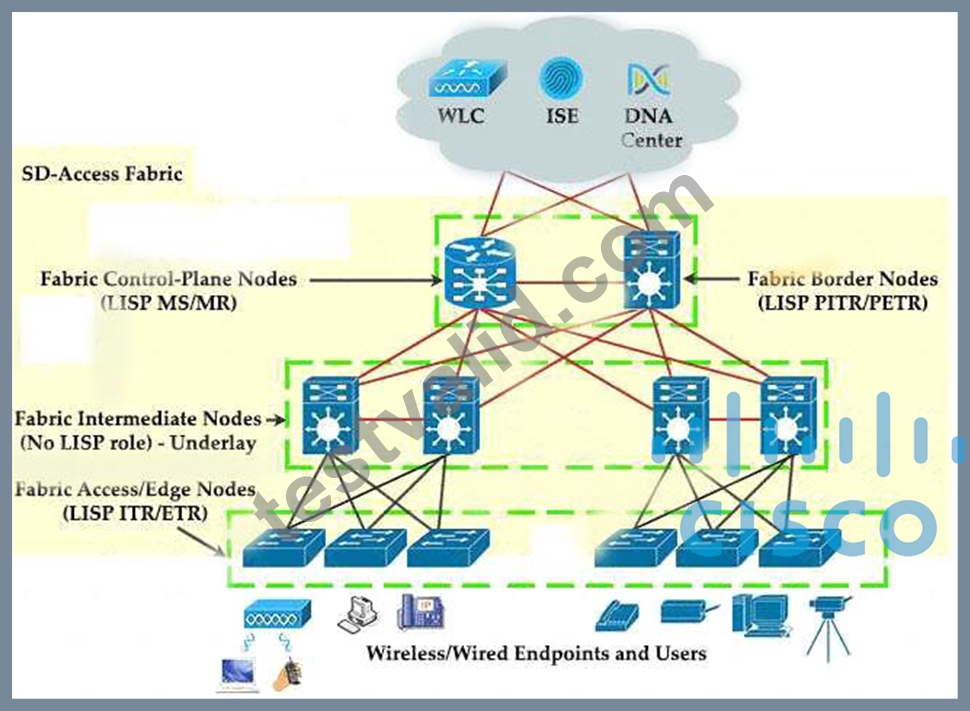
NEW QUESTION # 189
How does a fabric access point fit in the network?
- A. It is in FlexConnect mode and must be connected directly to the fabric edge switch.
- B. It is in FlexConnect mode and must be connected directly to the fabric border node.
- C. It is in local mode an must be connected directly to the fabric border node.
- D. It is in local mode an must connected directly to the fabric edge switch.
Answer: D
Explanation:
Fabric mode APs continue to support the same wireless media services that traditional APs support; apply AVC, quality of service (QoS), and other wireless policies; and establish the CAPWAP control plane to the fabric WLC. Fabric APs join as local-mode APs and must be directly connected to the fabric edge node switch to enable fabric registration events, including RLOC assignment via the fabric WLC. The fabric edge nodes use CDP to recognize APs as special wired hosts, applying special port configurations and assigning the APs to a unique overlay network within a common EID space across a fabric. The assignment allows management simplification by using a single subnet to cover the AP infrastructure at a fabric site.
NEW QUESTION # 190
Refer to the exhibit. Which privilege level is assigned to VTY users?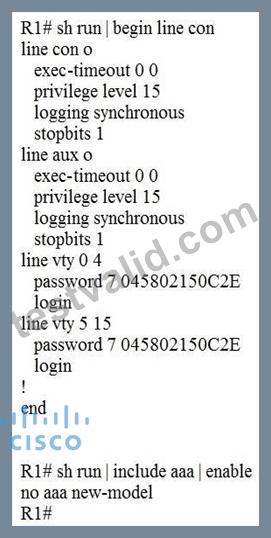
- A. 0
- B. 1
- C. 2
- D. 3
Answer: A
Explanation:
Lines (CON, AUX, VTY) default to level 1 privileges.
NEW QUESTION # 191
......
Cisco 350-401 ENCOR exam is a comprehensive exam that covers a wide range of topics related to enterprise network technologies. 350-401 exam includes questions on network architecture, virtualization, infrastructure, security, automation, and network assurance. 350-401 exam is designed to test the candidate's understanding of the latest networking technologies and how they can be used to build and troubleshoot enterprise networks.
350-401 Real Exam Questions and Answers FREE: https://www.testvalid.com/350-401-exam-collection.html
2025 Realistic Verified Free Cisco 350-401 Exam Questions: https://drive.google.com/open?id=12m3QvXd0g0TPBr8D7bPsZXrm2UGAT2jA