

FCSS_LED_AR-7.6 Practice Test Questions Answers Updated 127 Questions
FCSS_LED_AR-7.6 dumps & Fortinet Certified Solution Specialist Sure Practice with 127 Questions
Fortinet FCSS_LED_AR-7.6 Exam Syllabus Topics:
| Topic | Details |
|---|---|
| Topic 1 |
|
| Topic 2 |
|
| Topic 3 |
|
| Topic 4 |
|
NEW QUESTION # 50
A network administrator wants a newly deployed FortiGate to automatically discover its FortiManager without manual configuration. Which of the following must be correctly configured for this process to work?
Response:
- A. The DHCP server must provide a valid default gateway to reach FortiManager.
- B. FortiGate interface administrative access must have enabled Security Fabric Connection.
- C. The FortiGate interface must be set to receive an IP address over DHCP.
- D. The DHCP server must include Option 240 or Option 241 in its lease offers.
Answer: D
NEW QUESTION # 51
Refer to the exhibit.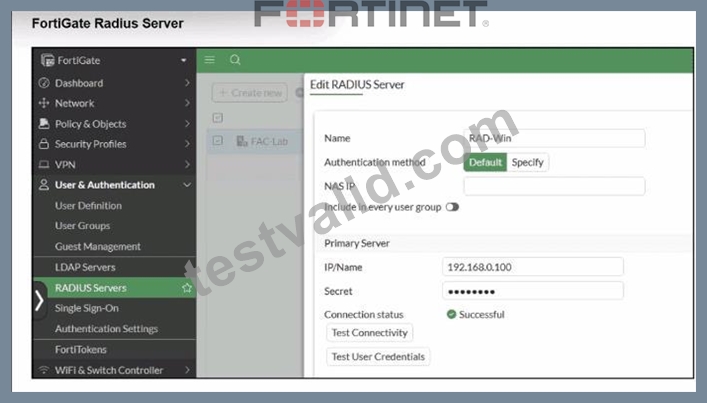

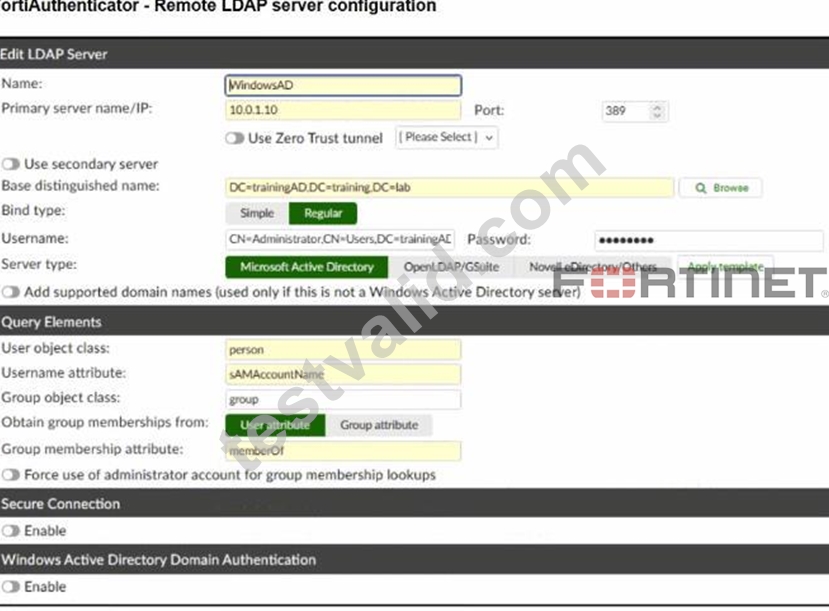
A RADIUS server has been successfully configured on FortiGate, which sends RADIUS authentication requests to FortiAuthenticator. FortiAuthenticator, in turn, relays the authentication using LDAP to a Windows Active Directory server.
It was reported that wireless users are unable to authenticate successfully.
The FortiGate configuration confirms that it can connect to the RADIUS server without issues.
While testing authentication on FortiGate using the command diagnose test authserver radius, it was observed that authentication succeeds with PAP but fails with MSCHAPv2.
Additionally, the Remote LDAP Server configuration on FortiAuthenticator was reviewed.
Which configuration change might resolve this issue?
- A. Manually add user credentials to the FortiAuthenticator local database
- B. Use RADIUS attributes under the FortiGate configuration.
- C. Change the RADIUS authentication protocol to CHAP
- D. Enable Windows Active Directory Domain Authentication.
Answer: D
Explanation:
From the exhibits and text:
* FortiGate #RADIUS# FortiAuthenticator
* FortiAuthenticator #LDAP# Windows AD
* diagnose test authserver radius ... papsucceeds
* diagnose test authserver radius ... mschap2fails
This behavior matches a classic limitation documented in FortiOS:
When usingLDAPas the back-end, the RADIUS server must usePAP. CHAP/MS-CHAPv2 arenot supported with plain LDAP because the server cannot validate the challenge-response without access to password hashes.
In the Remote LDAP server config on FortiAuthenticator, the option"Windows Active Directory Domain Authentication" is disabled.When this feature isenabled, FortiAuthenticator can talk to AD usingKerberos
/NTLMinstead of a simple LDAP bind, whichdoes support MS-CHAPv2for incoming RADIUS authentications.
So to allow MS-CHAPv2 all the way from FortiGate to AD, you must:
* Keep FortiGate using RADIUS with MS-CHAPv2 # FortiAuthenticator
* EnableWindows Active Directory Domain Authenticationso FortiAuthenticator can properly validate MS-CHAPv2 against AD.
Why the other options are wrong:
* A. Change to CHAP- CHAP still cannot be validated over LDAP; docs say LDAP back-ends must use PAP.
* C. Manually add users to local DB- That would allow local-DB auth but does not fix MS-CHAPv2 against AD.
* D. Use RADIUS attributes on FortiGate- Attributes do not influence the EAP inner method; they don't fix MS-CHAPv2 failures.
Therefore the configuration change that can realistically fix the MS-CHAPv2 problem isenabling Windows Active Directory Domain Authentication on FortiAuthenticator (B).
NEW QUESTION # 52
What capability does FortiLink NAC add to standard FortiLink behavior?
Response:
- A. Policy-based routing
- B. VPN failover routing
- C. Distributed SSID roaming
- D. Endpoint-based access control
Answer: D
NEW QUESTION # 53
Which two statements about the use of digital certificates are true?
(Choose two.)
Response:
- A. A certificate signed by an intermediate CA is still part of a trusted chain.
- B. A certificate revocation list (CRL) automatically removes revoked certificates from all systems in real time.
- C. CRLs are required only for self-signed certificates.
- D. Intermediate CAs help establish a hierarchical chain of trust.
Answer: A,D
NEW QUESTION # 54
Refer to the exhibits.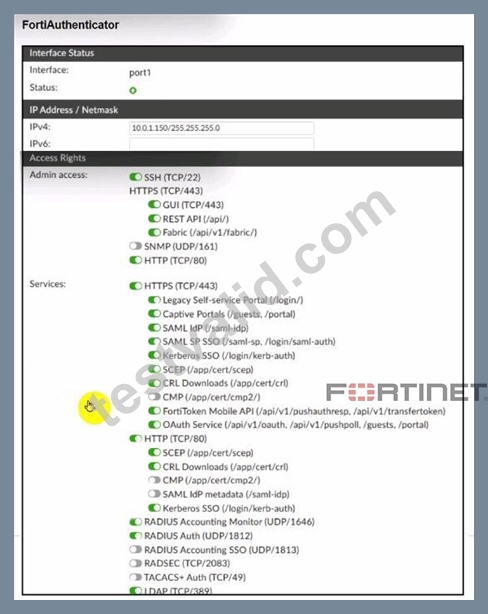
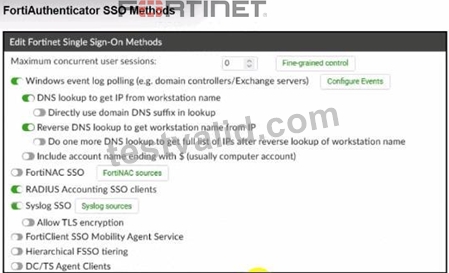
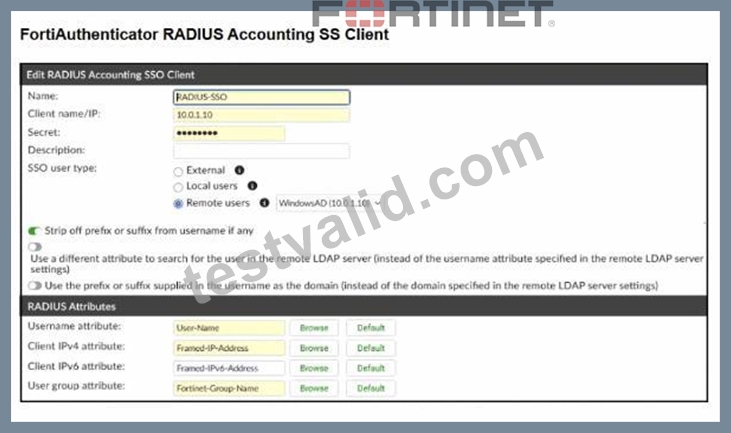
A company has multiple FortiGate devices deployed and wants to centralize user authentication and authorization. The administrator decides to use FortiAuthenticator to convert RSSO messages to FSSO, allowing all FortiGate devices to receive user authentication updates.
After configuring FortiAuthenticator to receive RADIUS accounting messages, users can authenticate, but FortiGate does not enforce the correct policies based on user groups. Upon investigation, the administrator discovers that FortiAuthenticator is receiving RADIUS accounting messages from the RADIUS server and successfully queries LDAP for user group information. But, FSSO updates are not being sent to FortiGate devices and FortiGate firewall policies based on FSSO user groups are not being applied.
What is the most likely reason FortiGate is not receiving FSSO updates?
- A. The RADIUS Username and Client IPv4 attributes are not defined on FortiAuthenticator.
- B. FortiAuthenticator is missing the FSSO user group attribute in the configuration.
- C. The LDAP server is not configured to retrieve group memberships for RSSO users.
- D. The FortiAuthenticator interface is not enabled to receive RADIUS accounting messages.
Answer: A
Explanation:
In this design, FortiAuthenticator receivesRADIUS accounting (RSSO) messages, looks up the user in LDAP to get group information, theninjects FSSO logon eventstoward all FortiGate devices.
From the exhibits we know:
* FortiAuthenticatoris receiving RADIUS accountingfrom the RADIUS server.
* LDAP queries are successful and return group membership.
* But FortiGatedoes not receive FSSO logons, so identity-based policies are not applied.
For FortiAuthenticator to create an FSSO logon, the RADIUS accounting record must be correctlyparsed into at least:
* Username
* Client IP address
These are mapped from the RADIUS attributes in theRADIUS Accounting SSO clientconfiguration (for example, User-Name and Framed-IP-Address). If these are not defined or mapped incorrectly, FortiAuthenticator can see the accounting packet butcannot build a valid FSSO session, so no update is sent to FortiGate.
Thus the most likely root cause is:
#The RADIUS Username and Client IPv4 attributes are not correctly definedfor that RADIUS Accounting SSO client (optionA).
Other options conflict with the scenario:
* B- LDAP is already successfully returning groups.
* C- FSSO user group attribute is separate; even without it, FSSO logons would still be created (just without group mapping).
* D- The interfaceisreceiving RADIUS accounting, so it is clearly enabled.
NEW QUESTION # 55
Which two configuration steps are needed to enforce authentication for guest access?
(Choose two)
Response:
- A. Create a firewall policy with captive portal
- B. Assign VLANs manually
- C. Define guest portal URL
- D. Enable endpoint discovery
Answer: A,C
NEW QUESTION # 56
To manually quarantine a MAC address in FortiGate CLI, which command is correct?
Response:
- A. config user quarantine → set mac <mac-address>
- B. diagnose quarantine mac add <mac-address>
- C. diagnose firewall mac blacklist <mac-address>
- D. config system quarantine → edit <mac>
Answer: B
NEW QUESTION # 57
Refer to the exhibits.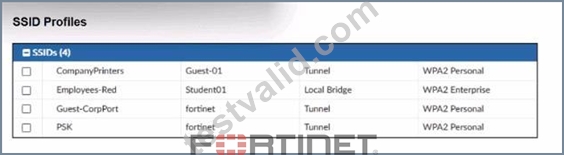
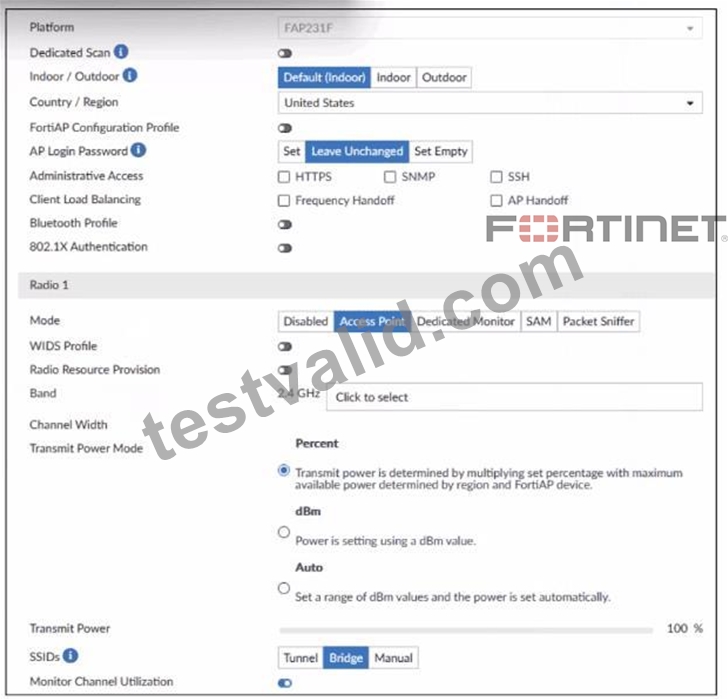
A set of SSID profiles has been configured on FortiManager, and an AP profile has been assigned to a group of AP managed by FortiGate. However, none of the designated SSIDs are being broadcast by these APs.
Which configuration change is required to make the APs broadcast these SSIDs as intended?
- A. Change the AP profile to use a platform that supports the configured mix of SSIDs.
- B. Set the Transmit Power Mode to Auto.
- C. Choose Manual in the SSIDs setting and select the SSIDs to broadcast.
- D. Adjust the AP profile to ensure all SSIDs are configured in a supported mode, either bridge or tunnel, but not a mix of both.
Answer: C
Explanation:
From the exhibits:
* The AP profile shows:
* SSIDs: Tunnel | Bridge | Manual
* The current setting isBridge, not Manual.
* WhenBridgeorTunnelis selected, the AP profiledoes NOT automatically broadcast SSIDsunless the corresponding VAPs were explicitly mapped in the AP profile.
* FortiManager SSID profiles are created, but unless these are explicitly applied underManual SSIDs selection, the AP will not broadcast any SSID.
Fortinet documentation states:
"To control which SSIDs an AP broadcasts, the AP Profile must have SSIDs set toManual, and the desired SSIDs must be selected." Therefore, to make the AP broadcast the intended SSIDs:
#You must switch the SSIDs setting to Manual, and manually select the SSIDs (CompanyPrinters, Student01, Guest-CorpPort, PSK).
Why the other options are incorrect:
* A. Adjust AP profile to avoid mixing bridge/tunnelMixed modes ARE supported. Not the issue.
* B. Change platformThe platform (FAP231F) already supports all listed SSIDs.
* D. Set transmit power mode to autoPower settings have nothing to do with SSID broadcasting.
NEW QUESTION # 58
Which statement about generating a certificate signing request (CSR) for a CER certificate is true?
- A. Inaccurate or missing fields in the CSR will prevent the CA from validating the request, leading to the rejection of the certificate and possible delays in the deployment process.
- B. The fields in the CSR are primarily for documentation purposes; any missing or incorrect information will be automatically corrected by the CA during the signing process.
- C. If key fields like the common name (CN) and organization (O) are incorrect, the certification authority (CA) will still issue the certificate, but it may not be trusted by certain applications or systems that rely on accurate field information for validation.
- D. CSR fields are primarily used for internal recordkeeping by the requesting organization, and only the public key in the CSR must be accurate for successful certificate signing.
Answer: A
Explanation:
The FortiOS documentation explicitly states that a CSR used for certificate signing must contain accurate and valid fields, especially:
Common Name (CN)
Organization (O)
Country (C)
Public key parameters
According to the FortiGate certificate section:
Incorrect CSR field information can cause the CA to reject the request.
Reasons include:
The CA validates identity and organizational information.
Missing or malformed data invalidates PKI requirements.
The CSR is not corrected automatically by the CA.
Therefore:
#A is correct.
Options B-D contradict PKI principles:
B is false: CAs do not issue certificates with mismatched identity fields for public trust.
C is false: CSR fields are not only for internal use; they define certificate identity.
D is false: CAs do not auto-correct CSR fields.
NEW QUESTION # 59
APs have been manually configured to connect to FortiGate over an IPsec network, and FortiGate successfully detects and authorizes them. However, the APs remain unmanaged because FortiGate is unable to establish a CAPWAP tunnel with them.
What configuration change can resolve this issue and enable FortiGate to establish the CAPWAP tunnel over the IPsec connection?
- A. Configure a static route on FortiGate to reach the APs over the IPsec tunnel.
- B. Decrease the CAPWAP tunnel MTU size for APs to prevent fragmentation.
- C. Assign a custom AP profile for the remote APs with the set mpls-connection option enabled.
- D. Upgrade the FortiAP firmware image to ensure compatibility with the FortiOS version.
Answer: C
Explanation:
When FortiAPs connect to FortiGate overIPsec tunnels, this is treated similarly to WAN/MPLS deployments.
In these scenarios, FortiGate must know that CAPWAP must traverse anon-L2transport.
FortiAP profiles include:
set mpls-connection enable
This setting is required so that:
* FortiGate can encapsulate CAPWAP inside the transport tunnel
* Remote FortiAPs can establish CAPWAP even when behind routed/IPsec networks Without this option, the FortiGate detects the AP butcannot bring CAPWAP UP, leaving the AP in
"discovered/unauthorized" or "offline" state.
Why others are wrong
* A. Static route# Discovery already succeeds, so routing is not the issue.
* C. Reduce MTU# Sometimes useful for IPsec, but not required for CAPWAP establishment.
* D. Firmware upgrade# Firmware mismatch would show "Managed (upgrade required)," not CAPWAP tunnel failure.
Therefore,set mpls-connection enableis the required fix.
NEW QUESTION # 60
Refer to the exhibits.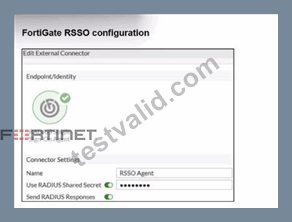
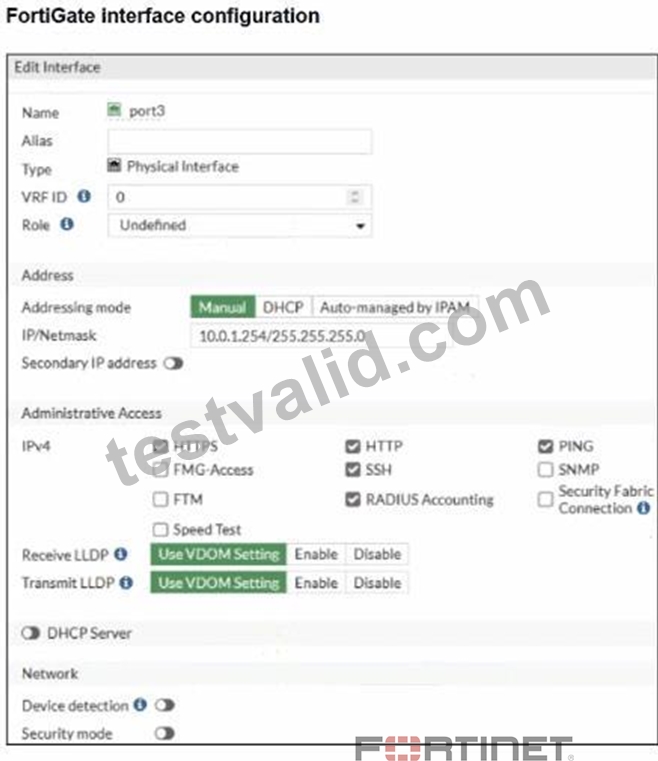
Examine the FortiGate RSSO configuration shown in the exhibit.
FortiGate is set up to use RSSO for user authentication. It is currently receiving RADIUS accounting messages through port3. The incoming RADIUS accounting messages contain the username in the User- Name attribute and group membership in the Class attribute. You must ensure that the users are authenticated through these RADIUS accounting messages and accurately mapped to their respective RSSO user groups.
Which three critical configurations must you implement on the FortiGate device? (Choose three.)
- A. Device detection and Security Fabric Connection should be enabled on port3
- B. RSSO user groups should be assigned to all firewall policies.
- C. The rsso-endpoint-attribute CLI setting in the RSSO agent configuration should be set to User-Name.
- D. The RADIUS Attribute Value setting configured for an RSSO user group should match the class RADIUS attribute value in the RADIUS accounting message.
- E. The sso-attribute CLI setting in the RSSO agent configuration should be set to Class.
Answer: C,D,E
Explanation:
The problem states:
* FortiGate receivesRADIUS accounting messagesonport3.
* User-Nameattribute contains the username.
* Classattribute contains the group membership.
* Goal: authenticate users through RSSO and map them to the correct user groups.
To achieve this, three critical components must be configured:
#A. RADIUS Attribute Value in the RSSO group must match the Class attribute This is mandatory because:
* RSSO user groups on FortiGate match users based onthe value inside the RADIUS attribute(usually Class).
* For group assignment to work, FortiGate must compare:
RSSO User Group # RADIUS Class Attribute Value
This isexactly how FortiGate maps RSSO users to groups.
#D. RSSO agent's sso-attribute must be set to Class
Thesso-attributedefineswhich RADIUS attribute contains the group information.
Because group membership is carried in:
#Class attribute
You must configure:
config user radius
set sso-attribute Class
end
This tells FortiGate:
"Use the Class attribute to derive user group membership."
#E. rsso-endpoint-attribute must be set to User-Name
This identifieswhich RADIUS attributecarries the actualusername.
In this scenario:
* RADIUS accounting messages contain the username inUser-Name.
* So the correct setting is:
config user radius
set rsso-endpoint-attribute User-Name
end
This ensures the RSSO user object uses the correct username.
#Incorrect Options Explained
B). Assign RSSO user groups to all firewall policies
Not required.
You only assign them to policies where RSSO authentication is used.
C). Device detection and Security Fabric Connection should be enabled on port3 Totally irrelevant to RSSO.
RSSO only needs RADIUS accounting, not device detection or Fabric services.
NEW QUESTION # 61
You are configuring a new wireless network for your organization. The network requires users to authenticate through a RADIUS server for secure access. Which two security modes should you select when creating the SSID to ensure compatibility with the RADIUS server?
(Choose two.)
Response:
- A. WPA3-Enterprise
- B. WPA-Personal
- C. WPA/WPA2 Mixed Mode
- D. WPA2-Enterprise
- E. WEP
Answer: A,C
NEW QUESTION # 62 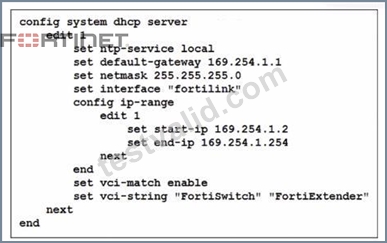
You've configured the FortiLink interface, and the DHCP server is enabled by default. The resulting DHCP server settings are shown in the exhibit. What is the role of the vci-string setting in this configuration?
- A. To connect, devices must match the VCI string; otherwise, they will not receive an IP address.
- B. To reserve IP addresses for FortiSwitch and FortiExtender devices.
- C. To ignore DHCP requests coming from FortiSwitch and FortiExtender devices.
- D. To restrict the IP address assignment to devices that have FortiSwitch or FortiExtender as their hostname.
Answer: A
Explanation:
The DHCP configuration shows:
set vci-match enable
set vci-string "FortiSwitch" "FortiExtender"
What this means
VCI = Vendor Class Identifier (DHCP option 60)
When vci-match is enabled, the DHCP server will only respond to DHCP requests from clients whose VCI string matches the configured vendor identifiers.
FortiSwitch and FortiExtender both send DHCP option 60 with:
"FortiSwitch"
"FortiExtender"
This is used in FortiLink deployments so only these devices receive IP addresses on the FortiLink network.
Therefore:
C). To connect, devices must match the VCI string; otherwise, they will not receive an IP address.
#Correct.
This perfectly matches FortiGate FortiLink DHCP behavior.
Summary of incorrect options
A - Ignore FortiSwitch/FortiExtender
#Opposite behavior.
B - Restrict based on hostname
#VCI does NOT check hostname.
D - Reserve IPs
#No reservation occurs; it's filtering, not reserving.
NEW QUESTION # 63
Which authentication method is triggered when a device does not support 802.1X but needs to access the network using its MAC address?
Response:
- A. MAC Authentication Bypass (MAB)
- B. RADIUS EAP chaining
- C. LDAP-based login
- D. EAP-TLS
Answer: A
NEW QUESTION # 64 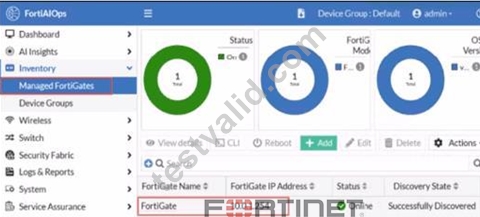
FortiGate has been added to FortiAIOps for management.
Which step must be performed on FortiAIOps to add a FortiSwitch device connected to the recently added FortiGate?
- A. FortiAIOps requires that the FortiSwitch IP address is submitted.
- B. Configure the FortiSwitch IP address, user ID, and password
- C. FortiSwitch is added automatically.
- D. Add the FortiSwitch device by submitting its serial number.
Answer: C
Explanation:
In a LAN Edge deployment:
* FortiSwitch is managedthrough FortiGate via FortiLink.
* FortiAIOps integrates withFortiGateas the single managed device; from there it gains visibility intoall Fabric and LAN-edge devices(FortiSwitch, FortiAP) that are registered to that FortiGate.
Once the FortiGate is successfully added to FortiAIOps (as shown in the exhibit, statusOnline / Successfully Discovered), all FortiSwitches managed by that FortiGate are:
* Discovered automatically through the FortiGate-FortiAIOps connection
* Shown under the appropriate inventory / switch views withno separate onboarding stepfor each switch.
This is why no extra IP, serial number, or credential entry is required for FortiSwitch.
So:
* AandBsuggest manual per-switch onboarding, which is not how FortiAIOps works with LAN Edge.
* Dsimilarly assumes direct FortiSwitch management, but FortiAIOps talks toFortiGate, not the switch.
Therefore the correct behavior is that theFortiSwitch is added automatically (C)once its managing FortiGate is connected to FortiAIOps.
NEW QUESTION # 65
When troubleshooting a captive portal issue, which POST parameter in the redirected HTTPS request can be used to track the user's session and ensure that the request is valid?
- A. magic
- B. email
- C. username
- D. redir
Answer: A
Explanation:
In FortiGate captive portal workflows (local or external):
* Client connects to SSID / interface that has captive portal enabled.
* Client makes an HTTP/HTTPS request.
* FortiGate intercepts and redirects to alogin page(local or external URL).
* The portal form is submitted viaPOSTback to FortiGate.
To prevent tampering and to tie the POST back to thecorrect user session, FortiGate includes a special hidden parameter in the redirect and expects it in the POST:
* The parameter is namedmagic.
The magic value:
* Is aunique tokengenerated per captive-portal session.
* Encodes/session-links the user's IP, interface, and session info.
* Allows FortiGate to ensure that:
* The POST comes from the user who initiated the original request.
* The request is not a random or replayed submission.
When troubleshooting:
* If the external portal does notpreserve and resendthe magic parameter back to FortiGate exactly as received, authentication fails, and you'll see errors like "session not found" or "invalid magic".
Why the other fields are not used for this purpose
* A. username- Just the login ID; multiple users can use the same username from different locations, so it can't uniquely track the browser session.
* B. redir- Contains the URL the user originally requested, so they can be sent back there after login. It is not a session integrity token.
* D. email- Optional field used in some guest/registration flows; irrelevant to session validation.
NEW QUESTION # 66
What role does FortiAuthenticator play in a guest access workflow with FortiGate?
Response:
- A. Acts as a DHCP server
- B. Deploys firmware to clients
- C. Captures traffic logs
- D. Authenticates guest users via SMS or email
Answer: D
NEW QUESTION # 67
Which Fortinet technologies can dynamically assign VLANs based on user or device attributes?
(Choose two)
Response:
- A. FortiCloud
- B. FortiAuthenticator
- C. FortiLink NAC
- D. FortiAnalyzer
Answer: B,C
NEW QUESTION # 68
Which CLI command displays managed FortiSwitch status from FortiGate?
Response:
- A. get system interface
- B. get switch-controller managed-switch
- C. show switch-controller global
- D. diagnose switch-controller get-conn-status
Answer: B
NEW QUESTION # 69
......
New FCSS_LED_AR-7.6 Exam Questions| Real FCSS_LED_AR-7.6 Dumps: https://www.testvalid.com/FCSS_LED_AR-7.6-exam-collection.html
Get New FCSS_LED_AR-7.6 Certification – Valid Exam Dumps Questions: https://drive.google.com/open?id=1OdkbvwerJvo6amZsTbHw9JNuL8HxtA6v